My title
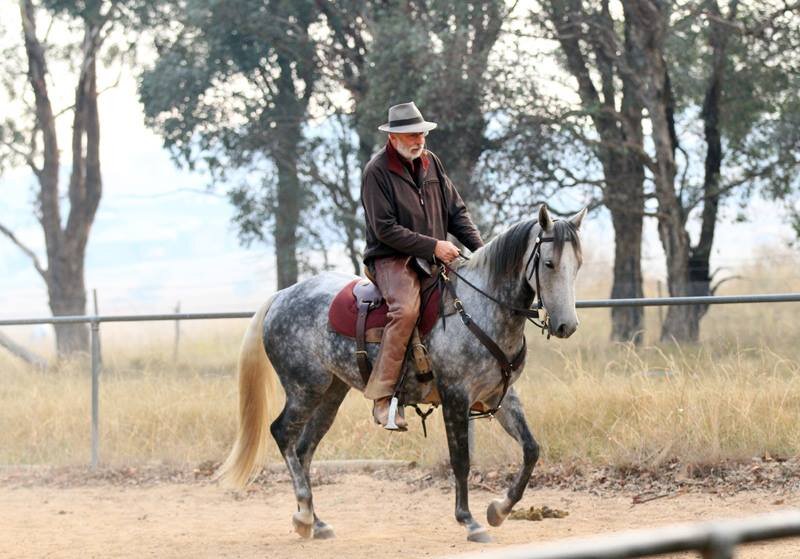
Their journey to understand life from the horse’s point of view has made Ross and Michèle
popular among horse owners who are looking for a willing partnership with their horses
.
stacks_image_4886B218-243C-43A5-BFBC-0C163BAF5A95
"In working with horses we try to keep the horse inside the horse." Ross Jacobs' and Michèle Jedlicka's philosophy to training is that simple. They believe that the thing that attracts people to horses and makes them want to share their life with them is the essence of a horse's nature.

"Horses are bigger and stronger than we are, yet have a gentleness and curiosity about them that seems childlike. They also have an immense capacity to try to get along and forgive all our faults when we present training in a way that they feel does not threaten them. Qualities such as these are sometimes lost when the human attempts to ‘train’ a horse.

"In the process of training we often try to eliminate essential parts of a horse's personality because they appear to get in the way of making him submissive. The very things they we often love about them we destroy so that we can turn them into performing robots." Ross believes this is a short sighted and unnecessary approach to training.
stacks_image_18BEFBA8-AFCC-409C-9BE3-9169788663F7
"Horses give their best when they feel good about the work and not perform simply because they have been trained to do a job. Just about all behaviourial problems are based on bad feelings the horse is experiencing about the work. Change the way he feels and you change the way he behaves. Part of that is not killing his personality." Ross and Michèle work every horse from a basis of understanding of what that horse is feeling towards the training and how the training can be modified in order to help each horse feel better about his role.

Michèle believes that to allow a horse to try something different from what they know, to venture further than they have before and come out the other side is key to helping a horse feel better about the horse/human relationship. "I think many people are unable to allow a horse to make a mistake, and put the animal in a situation where they can't get anything right. It's either the human's way or nothing, and that's not the way a horse functions. It kills their curiosity, their natural urge to know what is safe, and what will save them." When training, helping a horse to feel confident to try, even if it's not what she is eventually searching for is Michèle's goal. "If a horse feels they can offer something, anything, and that they will not be criticized or get into trouble, then I have a place to start. Most horses we see have learned that trouble is in order when a person is in the picture. I want to change that."
stacks_image_598AF95B-A64A-4405-A4F2-1C4DFA12FA1C
Ross thinks that, “Learning to understand what motivates the behaviour of a horse in a ‘moment to moment’ sense is the biggest obstacle that people face in their struggle to become good with horses. Once you learn to listen to how a horse feels inside, you can then learn to present yourself and your ideas to a horse in a way that feels good to the horse and will allow him to go along with your ideas with a minimum of fuss. You can’t work horses to a formula or recipe because a horse’s needs change every second let alone from horse to horse. Methods are not nearly as important as ‘feel’ when working a horse because if you have ‘feel’ you can adapt just about any method in a way that will feel good to a horse.”

“Learning to understand what motivates the behaviour of a horse in a ‘moment to moment’ sense is the biggest obstacle that people face in their struggle to become good with horses. Once you learn to listen to how a horse feels inside, you can then learn to present yourself and your ideas to a horse in a way that feels good to the horse and will allow him to go along with your ideas with a minimum of fuss.
You can’t work horses to a formula or recipe because a horse’s needs change every second let alone from horse to horse. Methods are not nearly as important as ‘feel’ when working a horse because if you have ‘feel’ you can adapt just about any method in a way that will feel good to a horse.”

Ross and Michèle are also committed to helping people learn the skills needed to ensure that their relationship with their horse goes from strength to strength. It is their policy not to accept a horse in training unless the owner makes a commitment to take the time to work with their horse under guidance. This might be once a week or every day.

Ross says, "Michèle and I urge people to come and visit as often as possible while their horse is here. Initially, they come to watch and ask a million questions, but as their horse progresses we get them to do more and more of the hands-on work. We try to have it so that the owners are feeling so comfortable around their horse that by the end of their time with us the owners are doing most of the work under our guidance. This is to help ensure that any confusion or difficulties in communication can be sorted out before the horse leaves here. It reduces the risk of serious problems arising at home."
Ross and Michèle have an established and successful business starting and re-educating horses for people interested in all forms of equine pursuit, from trail and pleasure riding, pony or adult riders club, to show jumping and advanced dressage. Additionally, they work with people who are struggling with problems their horses present. For more information about training, visit the link above or click here.

They are located in Garfield North (approximately 75km east of central Melbourne, Victoria). The facilities offered include an outdoor arena, round yard, generous, well maintained paddocks. Click
here for directions.
Disclaimer: This site contains information, advice and opinion formed by many years of experience by the authors. Any information, advice or opinion that does not specifically pertain to you and your horse should not be taken without first hand expert help. Information, advice and opinion expressed by the authors should not supersede the good and common sense of the reader when dealing with a horse in any situation. No information contained on this site is meant to be a manual for training or riding horses. Always seek first hand expert help for any problem. Opinions and views expressed on this site are those of the authors and not intended to offend or defame anybody and should not be taken seriously or out of context. It is a condition of entering this site beyond this page that you accept these terms. If you do not accept these terms, please do not read any further pages of this site. If you have any concerns or complaints please submit them to the authors