I have trained more than a few horses in my life. They ranged from unhandled babies to deeply troubled horses with years of experience.
Every one of those horses had their own issues. None of them behaved and responded to the training in precisely the way it said they should in any manual I had read.
One of the most common maxims I learned when I was a young horseman, still on my ‘L’ plates, was that it was better to purchase an unhandled horse than to buy one with problems inherited from previous handling. Buying a young and unhandled horse avoided inheriting mistakes and problems someone else put in your horse.
This idea of having a horse with a clean slate seemed to make sense and was strongly attractive. After all, why do I want to inherit someone else’s mistakes?
But with more experience, that principle proved a fallacy.
What I found is that if I didn’t have the skills and knowledge to fix an issue someone else put in a horse, then I didn’t have the skills and knowledge to ensure I didn’t put problems in a green or unhandled horse. If I didn’t know enough to fix a problem in an already trained horse, I couldn’t be sure I wouldn’t create problems.
The same skills I need to teach a young horse about tying-up are the same skills I need to address a tying up problem that was put there by somebody else. Likewise, if I am working a horse that is nervous, or won’t pick up its feet, or is resistant to the reins, or for almost any and every issue I might come across when training any horse. The skills I need to teach a horse something for the first time are the same skills I need to rehabilitate a horse with problems.
The reason for this is that problems in an experienced horse are due to gaps in the basic skills of focus, softness, clarity, and relaxation. These are the same basics that we want to instill in a green horse we are training for the same task. The skills we teach the untrained horse are the same skills we need to go back to in order to rehabilitate the experienced horse with problems.
In essence, the skills I need to educate a young horse are the same skills I need to rehabilitate an older horse. Therefore, when deciding to buy a horse that is a clean slate or one that is a fixer-upper the question should be, do I have the skills to ensure I can instil a solid grounding in the basics.
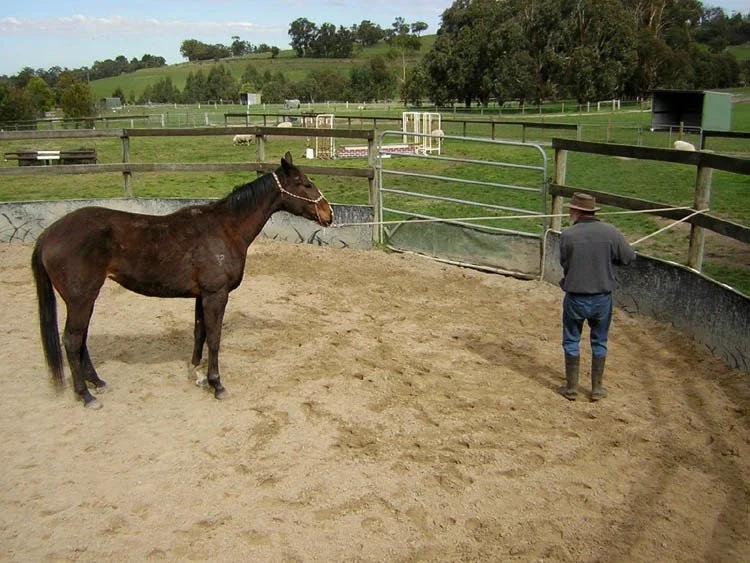
This horse had a chronic problem with pulling back when tied. Teaching it to give to a feel on the rope is in essence the same solution no matter whether it is learning to be tied up for the first time or overcoming an ingrained behaviour to pull back.