
The main reason why horses are hard to catch is that they are worried about the consequences that will follow being caught.
In the case of very young horses or horses with almost zero experience of human interaction, their worry about being caught comes from naivety or lack of experience. On the other hand, in regard to older horses, their desperation to avoid being caught is due to too much experience with people and resulting in bad outcomes.
Almost all catching problems are not about the catching process. It’s about a horse’s expectations of what happens after the halter, bridle, or lariat is fitted. In older horses, those expectations and the ill feelings associated with them are learned. We teach them. We teach our horses to feel anxious about being caught and the trouble that follows.
I have watched many videos demonstrating how to catch a “hard-to-catch” horse. They are mostly filled with clear and easy-to-implement exercises intended to change a horse’s need to flee the scene. Some apply positive reinforcement principles, and others rely on negative reinforcement methods. Most work with the final result of convincing a horse to allow itself to be caught. They all rely on changing their feelings by the handler saying, “C’mon, horsey. I’ll be nice to you. Promise!” in a sweet sugary voice.
But what I don’t see is an emphasis on addressing the cause of a horse being difficult to catch.
If a horse has learned to avoid being caught because what follows is associated with trouble, then teaching a horse to be willing to be caught can only come from addressing the trouble in the work we do after it is caught. We need to convince our horse that what happens after the catching is comfortable, soft, and safe. Only then does a horse learn that catching is not a terrible idea.
There are lots of reasons why a horse is not happy to be caught.
It could be related to being separated from the herd. It could be that we do too much driving and too little directing. It could be that we ask more from the horse than it is physically, mentally, or emotionally ready. It could be that we only work with our horse’s body and not with its mind. There could be physical comfort issues such as saddle fit, dental problems, hoof soundness, etc. The list is very long. But it is up to us to figure out what our horse needs from us to change the way it feels about what happens after we slip a halter on its head.
The point I am trying to make is that when we have a horse that is difficult to catch, most of us focus on methods to catch it. Very few of us look at the bigger picture of what created the problem. We focus on exercises designed to convince our horse that running away from us is a bad idea. Whereas, maybe we should give more consideration as to why our horse has learned that not being caught is a good idea.
I am looking forward to the day when hanging out with me is the highlight of my horse's day. I want to hear a knock on the back door. There, looking inpatient, is my horse all saddled up, yelling at me, “C’mon. What’s the holdup? Let’s go for a ride.” Then I can be certain I’m on the right track.
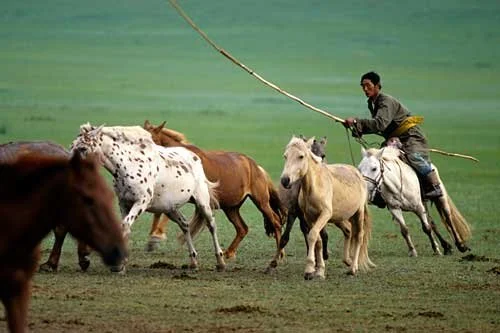
Mongolian herdsman catching horses.