I hadn’t had my driver’s license very long, so driving was still a bit of a buzz for me – especially by myself. One night, my parents let me borrow the car to attend a party hosted by some friends of friends in Glebe, Sydney. The condition was that I drank no alcohol and was home by midnight. I wasn’t into drinking, so that was no hardship.
The party was fun, and at about 11:30 p.m., I left and headed home. I wasn’t too sure of the area, but I figured if I drove around a bit, I would find a major street that would take me back to the Sydney Harbour Bridge, and then I would be right. After a few minutes driving, I started to think, “Where the hell was I?” I kept driving and ended up down some small one-way streets that looked like nothing I knew. When I put on my indicators to turn down another street, the headlights dimmed to almost nothing. It dawned on me that the alternator had not been working, and the car was working off a rapidly deteriorating battery. In fact, so bad was the situation that on the next turn, the car stalled. I managed to let it roll to the curb and off the street. I didn’t know where I was, and Dad’s car had broken down. I was getting just a little bit worried.
I scanned the street and saw a phone box on the corner about 200 metres away – this was in the days before we all had mobile phones permanently grafted to our ears. I got out of the car and looked around to see if there were any dangerous types around. It was certainly not the sort of neighbourhood that a middle-class suburban boy like me was familiar with or comfortable spending too much time hanging around at midnight. I made a brisk sojourn towards the telephone box. When I got there, I saw that it had been vandalized and was not in working order. Another burst of adrenaline was released into my system, and my heart was beginning to race. This was not a good situation. I was cold, lost, alone, broken down and nervous. What was I doing here in the middle of the night?
I made my way back to the car to think about what to do next. When I got about halfway to the car, four guys came around the corner towards me. They looked like locals looking for trouble. At first, they were skylarking, swearing and pushing each other around. Then one of them saw me and stopped to point me out to the others. They all looked at me. I turned and started to walk back to where I came from. I was sure I was in trouble. My heart was jumping out of my chest. I heard them calling out to me, but I didn’t answer. The only thing that kept me from running was that I was sure it would encourage the gang to chase me. If they did that, I knew they’d catch me and beat the daylights out of me. I didn’t know what I was going to do. They kept calling, and their shouts seemed to be getting closer. I was scared and walked as fast as I could. I was walking so fast that I was probably going as quickly as if I were running.
When I came to the end of the street, convinced that the gang was just about caught up to me, I dashed around the corner and bumped full throttle into a middle-aged couple going for a walk. I was so crazed with fear that I was sure they were part of the gang there to kill me. With the shock of it all, I dropped dead right there, and they buried me the next week!
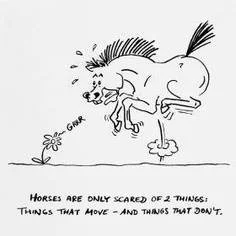
Some of you may not believe that is what happened or that I even died that night. And maybe you’d be right. But I bet every one of you has ridden a horse that has gone through the same or worse fears that I went through that night.
None of the things that happened to me were actually life-threatening or even scary on their own when taken as individual events. At no time was my life in danger. Yet, when each unfamiliar circumstance is added to by another unfamiliar circumstance, they take on a whole different meaning to us. Things spiral out of control. It is not rational, but it is real.
If my dad’s car had broken down near home and I had to walk home and came across a group of fellows walking towards me on my way home, it would not have bothered me in the least. But the unfamiliar and the lack of confidence that the unfamiliar bestows on us changes everything.
This is just as true for our horses.
How many of you have horses whose paddock turns into a mud bath during the rainy season? Yet how many of those same horses won’t ride through the mud or puddle when you take them out on a trail? What about the horse that is at a competition and flies off the handle when a dog barks, yet wouldn’t even blink an eye at the same circumstances at home?
Think about the horse that is taken out of the paddock away from his mates. He’d like to be with his mates because he feels safe with them, but he goes along with you in any case. Then you load him onto a horse trailer. Now he never feels 100% comfortable in a trailer – especially alone. But he has done it enough times to feel he should be polite about it, even if it takes you a couple of tries to get him in. He is driven along the freeway with traffic flying past. Trucks are sitting right behind him. The trailer is getting stuffy because there is never enough ventilation. He is away from everything that is familiar, and he is by himself. You get to your destination at the showgrounds and your horse walks out of the float into a kaleidoscope of activity, smells and sights that are totally foreign to him. He spots other horses and thinks maybe they could offer some support or comfort to reassure him that things will be ok. But you drag him away from them because he has to be made presentable for his class. Your nerves and his nerves become cumulative as you take him over to the warm-up ring. Horses are whizzing around and coming from all directions. The bunting is flapping, dogs are barking, and people are pushing strollers. It’s all too much, and your horse can no longer hold his composure in check – goodbye blue ribbon.
But it doesn’t have to be something as big as going to a competition to challenge a horse’s confidence. Just leading a horse away from its paddock is enough for some to cause them to be afraid for their life. I had a horse in training that changed from Dr Jekyll to Mr Hyde just by putting a saddle on. This poor mare had a total personality shift because of the fear a saddle instilled. Take the saddle off, and she was a pleasure to handle, but put the saddle on, and she grew two hands. This is not a matter of the saddle causing pain to the horse, but emotional stress. We sometimes see it as being naughty, but to the horse, it can be a matter of life and death.
None of us can really know how a horse feels, but we have to accept that their feelings are real. It is not fair or even good horsemanship to try to invalidate the way a horse feels by forcing them into a situation that they feel threatens their survival. There is no doubt that you can force a horse to submit to fearful circumstances, but you are only overriding his fear of one circumstance with his fear of disobeying you. It is a slippery slope that is sure to fail in the long run, either by causing a bigger behavioural problem or by killing the “try” in a horse so that you never get the best that your horse has to offer.
Every time a person ignores a horse’s fears or puts the horse in a situation that the horse feels will jeopardize his safety, the horse is learning that his survival and well-being are not important to the human. It is like saying to the horse, “I don’t care if you are going to die, you’ll do what I tell you anyway.” If you do this enough times, he will learn that he can’t trust you with his safety. You are not to be relied upon, and he will try to take over in matters that make him feel anxious. It doesn’t make for a very harmonious partnership between you and your horse. In fact, it will tend to lead to a relationship that is more like a war zone and who wins will depend on the strength of will of either you or your horse.
So the message once again is to work on how your horse is feeling and not what he is doing. If you change his feelings, you automatically change his responses. Good horsemanship is as simple and as hard as that.