I received an email a couple of days ago. There was a question.
“I bought a 9 yo a horse that has been given hand treats. He’s really food motivated, so I’m avoiding all treats because I’m unsure how I’d manage it. The Question is, how to move away from a horse’s expectation that a treat should come after any effort?”
Many people teach their horse that if they are rude enough, they will get a food reward. Unfortunately, you have inherited such a problem and are now left to figure out how to change your horse’s behaviour.
For most horses, food is a powerful motivator of behaviour. If a horse believes there is something good to eat in your pocket, it will do whatever it can to access the food. But knowing this tells you how to change the pushy behaviour.
Firstly, you are right to stop giving your horse food from your hand. He has learned that pushing on people results in being given a treat, so stop reaching into your pocket or bucket or whatever and giving him a treat. Over a period of time, your horse will learn that crowding you and pushing on you no longer results in a reward.
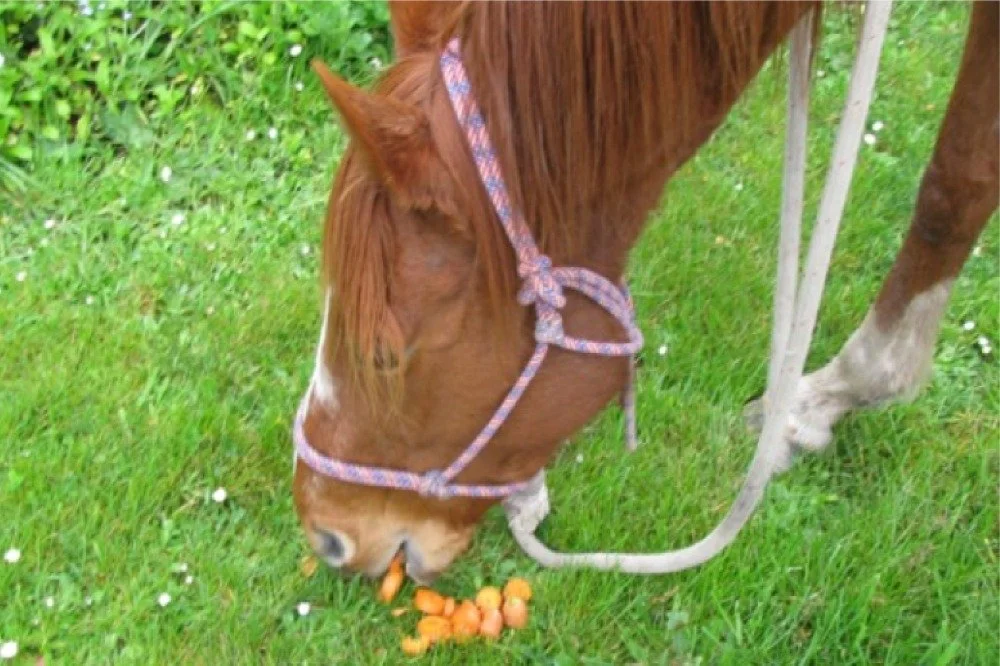
But the “no pushing” rule needs to be reinforced and become the new normal. To do this, when he stops pushing, you put a small amount of food treat on the ground, away from you. Let him enjoy a slice of carrot or apple that does not come from him pushing on you.
So the new rule is if there is any sign of pushing on you for a treat, your horse does not get a treat. But if he is polite and entitled to a reward, the treat is available from another source.
That is a principle I have explained to students many times in the past. But there is another approach that a more experienced person might consider.
When a horse is seriously motivated to search you for food, it is because the food he is expecting is highly valued. If a horse loves carrots, don’t treat him with carrots. If he only has a mild interest in apples, you might reward him with apple slices. The object is to make available only treats that are less palatable. This will discourage a lot of the pushiness because the treat loses some of its importance.
However, the horse is described as “really food motivated”. In a case like this, I might try making the treat in my pocket that he loves, less delicious and even distasteful.
You could try using his favourite food, but coat it in something your horse does not like. For example, you could dip carrot slices in a watered-down solution of soy sauce and offer them to him when he pushes on you. Or you could use slices of eggplant. Allow the horse to be pushy, offer him the yucky treat, and let him learn for himself that his rude behaviour is not a rewarding behaviour. You are not telling him that he is not allowed to search you for a treat. You are only letting him discover for himself that his bad behaviour does not work out so well in his favour. He will stop it.
The principle is to turn a highly valued reward into a poorly valued treat.
Another aspect of the training is to use an alternative reward that your horse values. This could be a scratch on his favourite itchy spot. It could be a short period of no-pressure downtime. It could be that you offer 30 seconds of grazing (note that I said “you offer” - not “your horse takes”). Use your imagination and understanding of what your horse values.
Of course, it is best if we don’t let our horse develop a fixation on us giving it treats. This is where our horse sees us as nothing more than a vending machine. It creates ill feelings and a breakdown in good relations when we withhold the treat or the treat is of low value.
If you are going to offer food treats to your horse, do it with care and be smart about it.