There is a lot of discussion and lecturing about the use of energy when working with horses. Energy is certainly a factor in being an effective rider. But energy in itself does not tell a horse what to do or how to do it.
For instance, I can ask my horse to canter while using so little energy that an observer would think my horse and I were using telepathy. Yet, in the next moment, I might explode with energy while trying to shoo away a wasp that was buzzing around me, and my horse would ignore the sudden eruption of energy.
It is not energy or the amount of energy that my horse responded to. It is the way I applied the energy. Energy in itself has nothing to teach a horse. The role of energy is simply to engage a horse’s thoughts to search for an answer. When we apply no energy, it should indicate the horse does not need to do anything. A little energy might mean it should check in with us and try to figure out what our question might be. A lot of energy should tell a horse that there needs to be some urgency in answering the question we ask.
To be clear, the role of energy is to inspire a horse to search for a response. However, when applied with clarity, a small amount of energy can be far more effective in creating the desired response.
I bring this up because I know when we are stuck in getting a change in a horse, many of us bring out the “big guns”. When our horse is unresponsive to our forward aids, we reach for a whip or spurs. When it won’t stop or slow, we use a bigger bit. All are designed to add more energy in the hope that we are more effective. But if we don’t apply that energy (big or small) with sufficient clarity, we only add to our horse’s confusion and stress.
But how to add more clarity?
Definition: Clarity is when our intent is unambiguous to a horse. A lack of clarity is when a horse is unsure of our intent.
An example of clarity might be if I asked you what time is it now in New Zealand? This question has a very specific, unambiguous answer. The word “now” tells you the time I refer to. The mention of New Zealand tells you the time zone I am asking about.
But an example of a lack of clarity would be if I asked you what day is today? This question has multiple possible answers. It could be Friday, or it could be my birthday, or it could be laundry day, or it could be “International Hug An Aussie Day”. The question is ambiguous, and the clarity is poor. You would be confused and stressed because the correct response is unclear. It wouldn’t matter how loudly or how much energy I applied to the question, the answer would still be unclear.
The other aspect of clarity is to always ask a horse a question for which the answer is close to what it already knows. The purpose of energy is to inspire a horse to search for an answer. Clarity is only possible if the answer it is searching for is already within its realm of choices. Eg, if a horse has never pulled a cart, you don’t begin the harness lesson by using energy to force it pull a wagon. You begin with groundwork, leading exercises, long reining, etc. Clarity is only possible if the horse already understands how to offer the response we want. You can’t expect a horse to perform a piaffe if it does not know all the steps in the training that lead up to performing a piaffe.
Clarity involves asking a horse questions that have answers close to what it already knows. This is very important because asking a horse questions that it can’t answer stimulates anxiety and triggers survival behaviours.
So why does a small change in my body tension suggest to my horse to think about a canter, but a huge explosion of energy to shoo a wasp away triggers no change in my horse? Why does a pony trot when its rider bumps their leg against the pony’s side, but ignore the bump of the legs every time the unbalanced rider flaps around in the saddle?
The answer is not the amount of energy, but the clarity with which we apply the energy - big or small.
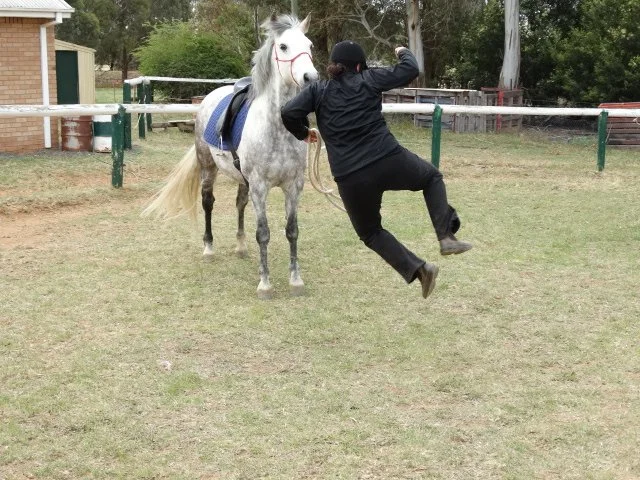
Gel has a lot of energy for her horse, but maybe not much clarity