THE INSIDE LEG
Something that comes up often, and is indeed a frequent topic of discussion and confusion at many of my clinics, is when a rider should use their inside leg to ask a horse to yield.
Growing up in the style of European dressage, I was drilled that I should use my inside leg for every circle, turn, and lateral movement. I was taught that without the inside leg, the hindquarters of the horse would fall to the inside on a circle, drag behind the forehand in my lateral work, and my horse would not be able to bend if the inside leg was not against the sides of a horse to bend around. It is no wonder that I became paranoid about using the inside leg correctly. I had nightmares that if ever I lost my right leg in an accident, I would only be able to ride left-hand circles and lateral movements to the right! How did those side-saddle riders ever manage to get their horses to turn left correctly? It must have sorcery. How do horses manage to lunge correctly on a circle without somebody chasing them with a stick and poking into their ribs the whole time?
So let me start with the problem of using the inside leg as I see it in my work as a clinician.
At a guess, about 90 per cent of horses that come to clinics don’t understand the rider’s intent when they apply the inside leg. For the vast majority of horses that I see, application of any leg pressure means only one thing – go forward.
Try this test for yourself. Drop the reins and fold your arms while your horse is standing still. Apply a feel in your left leg against your horse. If it understands the meaning of your leg, it will yield its hindquarters to the right. If it doesn’t, it will move forward instead.
When I give this test to people at clinics, there is often a look of shock on a rider’s face because they have been using the inside leg for years and years in the belief that their horse was yielding to it. But in my experience, most don’t. I can only think of five horses in the past couple of years that have passed this test at a clinic. Even horses competing in advanced competition and those with a decade of dressage training have failed it.
So the questions become: why have these horses not learned to yield to the inside leg, and what should be done about it?
It seems that most riders begin using their inside leg to direct a horse’s hindquarters from very early in a horse’s career. For most, it starts by the rider simply applying their leg in conjunction with the reins when asking for a turn or circle. The reins and the rider’s leg are applied simultaneously. And this is where the problem begins.
When we start teaching a horse to be ridden, we spend some time with the lead rope and the reins to follow a feel and yield in response to the reins. Likewise, we teach them to move forward in response to a feel from the rider’s leg(s). So a horse knows to turn in response to the reins and go forward in response to the legs. Then we decide it is about time our horse learned to perform balanced turns and circles, so we apply inside leg at the same time as using our reins. But we did not take the time to teach the horse that inside leg means it is to yield its hindquarters. We just seem to assume it will get it because that’s the proper way to ride a circle. Surely our horse has read the same books and watched the same videos we have on how to ride a circle correctly? But most horses are stuck with the idea that the reins are for turning and flexing and the rider’s legs are for going forward. We never took the time to teach our horse that the rider’s legs mean go forward when we do X and yielding their hindquarters when we do Y. In lots of horses’ thinking, doing X or Y means the same thing – to go forward.
When our horse executes the circle, we automatically take it for granted that yielding to our inside leg was partly responsible for how it happened. But for most horses, this is not true. It has been the shift in a rider’s seat (to a small degree) and the feel of the reins (to a large degree) that led to the circle. In the case of most horses, our inside leg was just responsible for the horse not stopping or slowing.
In order for a horse to understand what it means when a rider applies an inside leg, a horse actually has to be taught it. It is only a few horses that learn it by osmosis, and that usually can only happen over a very long time of consistently using the inside leg.
So how do I teach a horse to yield to my inside leg?
I begin by teaching him to give to the reins brilliantly. The reins influence both the flexion and the feet by directing the horse’s thought in a way that describes a circle, turn, or lateral maneuver. By using the reins to get a horse to think about going where I want, the horse follows the feel easily. I teach them the reins can direct the mind so that the front feet move only (eg forehand yield or turn on the forehand) or the back feet move only (eg hindquarter disengagement or turn on the haunches), or they move in unison (eg circle or shoulder in). At this stage, the only role of the rider’s legs is to suggest energy or life in the feet, but the reins do all the work of helping a horse choose what to do with that energy.
It is very important that a horse is first very clear about following the feel of the reins when a rider’s leg comes into play. This is because the reins offer a very refined aid that can be adjusted in very small increments. On the other hand, the rider’s legs and seat are much more coarse, and it is not possible to be as refined in signals coming from the legs and seat as it is from the reins. I can offer changes in the feel of the reins of a couple of grams or so. Yet, my legs and seat cannot offer anywhere near as small a change that would have meaning for most horses.
When the connection between my reins and the horse’s feet is good enough, it is time to introduce yielding to the rider’s leg. It really is a simple process now that all the hard work of connecting the reins to the horse’s thought has been accomplished. I usually begin at a standstill. First, offer a feel from the inside leg against the side of the horse. Inevitably, the horse will try to move forward in the beginning. Block any forward movement with the reins and then use them to indicate that you want the hindquarters to step away from the inside leg. Repeat this several times - inside leg followed by reins. In no time at all, a horse will understand that the inside leg means yield with the hindquarters. A rider can teach a horse the same principle with yielding the forehand to a rider’s outside leg.
This is the first step to truly teaching a horse to yield to the rider’s leg. From there, the world is your playground. You can begin to use legs to indicate balanced turns or any sort of lateral movement you wish. But it does need to be taught. A horse does not inherit knowledge about the feel of a rider’s leg from birth. Just like a horse must be taught how to respond correctly to every other aid we present.
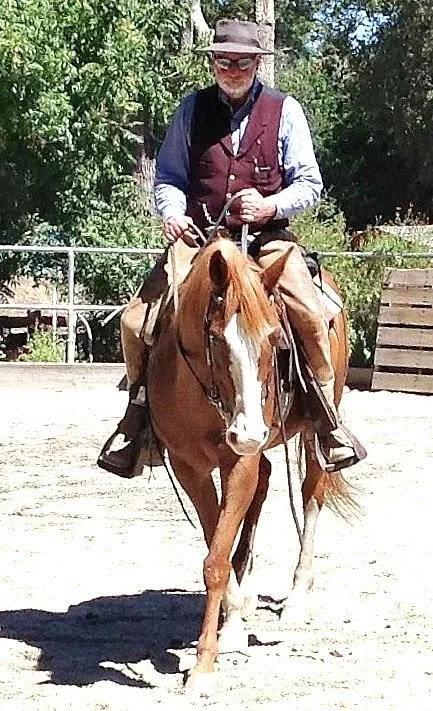
I am teaching a young horse to leg yield in response to a feel on my reins only. I am using no leg to indicate a sideways movement. The role of my legs at this stage is purely to maintain forward. My reins (and some seat) are entirely responsible for giving the horse the idea to flex laterally and cross its feet. Later, I will refine this movement by adding the idea of giving to the inside leg.