
In the comments section of a very recent post, the concept of timing the release of pressure was mentioned (thanks, Miriam Tell). She stated, “Somewhere I read that we have 3 seconds to reward, before they’ve moved on.” I have previously written about the timing of releasing pressure, but Miriam’s comment has prompted me to revisit the subject, given its importance.
We must always wait for a change of thought before releasing the pressure. That’s a fundamental principle that underlies my approach to training. If you don’t understand this concept, you won’t understand the rest of this essay. So please give it some serious thought.
I’d like to say that this topic is relevant whether we use negative reinforcement and release pressure or whether we use positive reinforcement and add a reward. The argument for timing with either of these approaches is the same.
Let's now talk about the timing of the release.
Most of us are taught that the moment a horse responds in the way you want it to, the pressure should be removed. This marks the moment the horse did the right thing, and it will learn from this what the right thing was. There is a widely held belief that the sooner we release the pressure when a horse offers the right response, the clearer it will be to the horse. Hence, the 3-second rule mentioned in Miriam’s comment in the previous post.
I’m going to ask you to rethink this bit of wisdom.
I don’t believe it is necessarily true that the pressure needs to be released the instant the horse does what we want.
Here is why.
The release of pressure rewards a horse for the thought that occupies its mind at that moment. For instance, if you ask a horse to back up and it moves back while it is thinking to bear down heavily on the rein, releasing the pressure at that time will teach the horse that backing up with resistance is its best option and the right thing to do. Instead of releasing because the horse moved back, we should release because the horse thought back.
So, how does the 3-second rule fit into this thinking?
Ask yourself, what if my horse thinks to back up for only 2 seconds? Releasing at 3 seconds would be too late, and you are releasing the pressure for the wrong thing. Well, what if the horse is thinking of backing up for 10 seconds? You could release the pressure at 3 seconds and reinforce the idea that backing up is the path to comfort. Or you could wait for 9 seconds and have the same outcome as if you released at 3 seconds.
A horse learns that the idea that occupies its mind at the moment we release the pressure is its most comfortable choice. Therefore, we can release the pressure at any time as long as the idea we want the horse to have is at the forefront of its mind. In other words, we don’t have to release the pressure the instant the horse has a change of thought. We only have to release the pressure while the horse holds onto the thought we want.
For example, if we ask a horse to turn left by applying the left rein and he then thinks to the left as his feet move to the left, we have from that moment to however long it is before another thought enters his mind to release him to associate the release of pressure with thinking and turning to the left.
If the idea to turn left lasts 1/10th of a second, we have 1/10th of a second to release the pressure. But if it lasts 10 seconds or 10 minutes or 10 weeks, we have 10 seconds, or 10 minutes or 10 weeks to release the pressure before we have missed the chance for the horse to learn from the release of the left rein.
As long as we release the pressure within the time the horse has the same thought we want him to have, we are okay with our timing.
There is a reason why I want you to think about this.
When you are working on releasing the pressure the instant a horse gives to the pressure, it tends to encourage most people to release the pressure with sudden abruptness. To avoid being late with their release, most people suddenly drop the feel of the pressure in a flash. This can often surprise a horse and the sudden loss of all feel can even cause anxiety.
We should never be abrupt or sudden in the way we either apply pressure or release pressure. We should always be working to be smooth to avoid adding another layer of worry to the horse. So, realising that we have as much time to release the pressure as the horse holds onto the new thought we want him to have, takes the need for us to release the pressure abruptly, which avoids adding more anxiety and thereby helps the horse associate the release of pressure with the thought we want it to have.
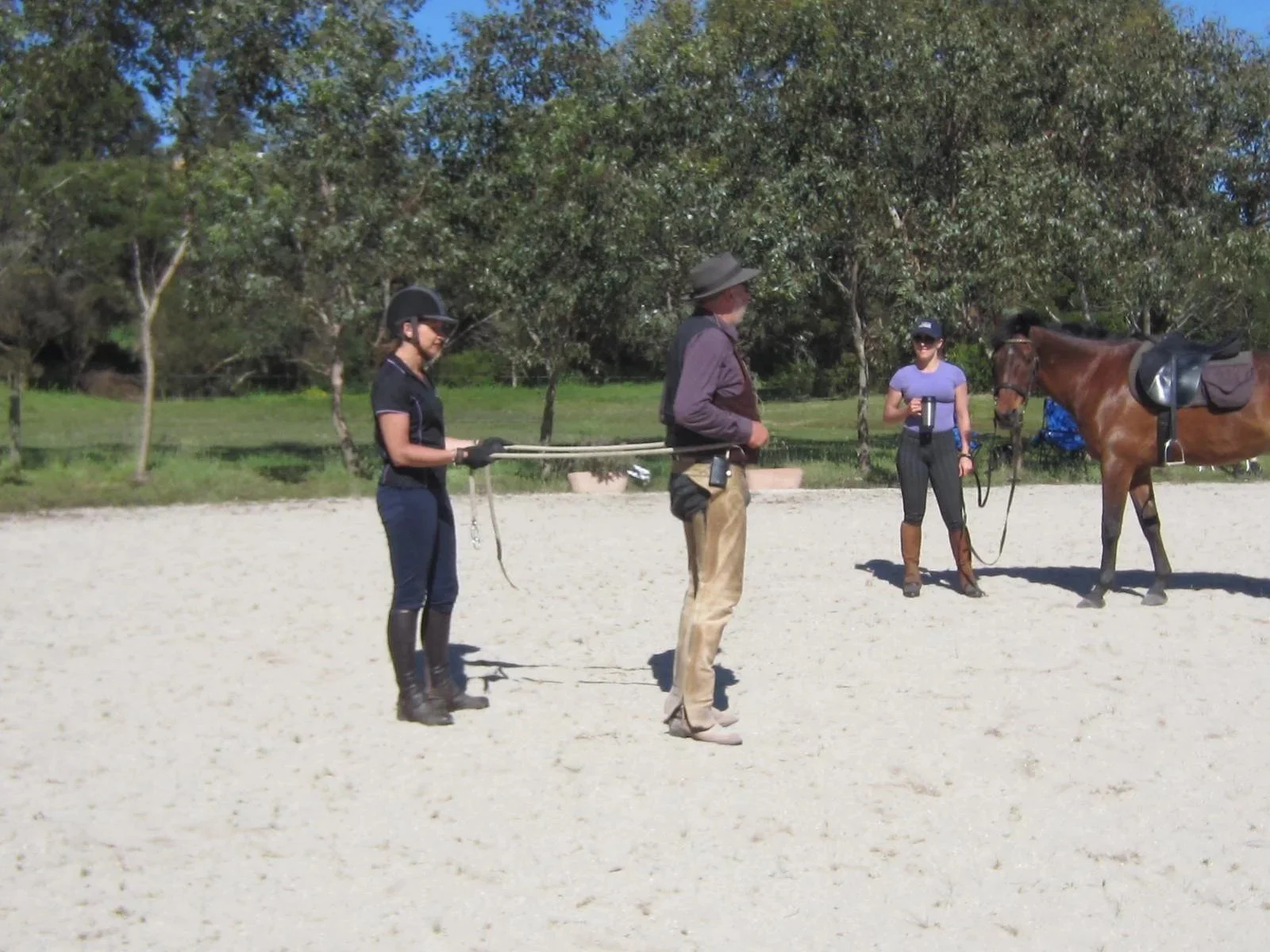
At a clinic, a student is waiting for me to change my thought from pushing into the rein pressure to thinking about coming off the pressure.