I want to talk about voice commands. It seems more and more people I meet are using voice commands – especially when lunging their horse. In fact, someone was very excited to show me how well their horse responded to their voice commands. I agree that the horse did walk when told to walk, trot when told to trot, canter when told to canter, and even stop when told to whoa. It all happened, as she required. But there is a problem with voice commands that I think people don’t always appreciate.
The issue from my perspective is that when you ask a horse to walk, or trot, or canter, or whoa from your voice, the walk, trot, canter, or whoa your horse gives you is the one you get. You have to accept that he will give only 1 type of walk and only 1 type of trot, etc. Using your voice to instruct a horse to trot does not give you much influence over the type of trot you might get. It will be what he gives you and nothing else. So if you want a bigger trot or a slower trot, etc., you have to interrupt what he gives you with body language and physical cues. It would be great if a horse could respond to more complex voice commands like “extended trot”, “collected trot”, “medium trot”, and “slow trot”. But they don’t.
It is thought that horses have about 9 sounds in their vocabulary. So they are born only understanding nine sounds that another horse may make to them. With this in mind, it would seem self-evident that vocalization does not play a prominent communication role in a horse’s world. For the most part, they rely on body language to get their meaning across to another horse. Horses are brilliant at interpreting the minutest nuance of body language. But they are really poor at working out sounds and totally useless at complex sounds. That’s why you can’t teach a horse to respond to “trot four steps, stop and walk six steps” from purely voice commands. If you want to teach this routine, you have to use physical pressure.
My point is that while you can teach a horse to respond to a very simple voice command, I don’t see that it has any useful function unless you are somebody like Stephen Hawking who is physically incapable of using body language. Voice command serves no practical purpose in training because rarely do you want the horse to decide the quality of the work he puts out. If you want to be able to influence how he does something, then you’ll have to resort to using body language.
Having said that, I know somebody will argue with me that their horse does respond well to voice commands and even complex commands. People have told me this in the past. But not once has anybody demonstrated to me that they are able to sit in a chair, totally motionless, and use their voice to get their horse to respond in the way they claim. Until that happens, I will remain sceptical of their claims.
Another criticism I hear about my views on the importance of voice commands in training is that people will say something like, “But at your clinics and on your videos, I hear you talking to the horses all the time.”
That’s partly true. But it is not for the benefit of the horse. I talk for the benefit of the students who are not sure of the intent behind the use of my body language. People don’t read body language very well, so I use talking as a tool for teaching students, not horses. People understand speech much better than they understand body language. So I use body language for the horses and speech for the humans.
I doubt using one's voice does any harm unless you come to rely on it. But I also don’t think there is much advantage to using it either. So why bother?
Photo: Having a good ‘ol chat
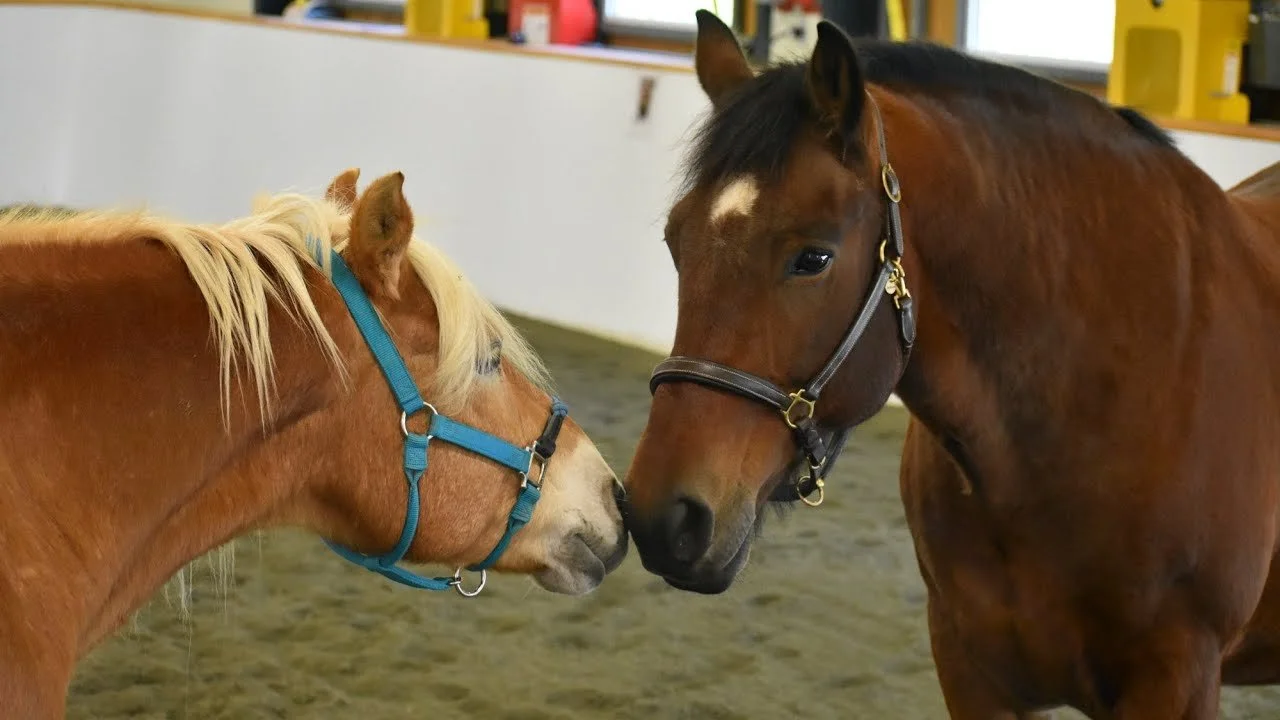
Horses having a good ‘ol chat