WHAT I SEE WHEN I FIRST LOOK AT A HORSE
When you look at a horse, what catches your attention first? What do you immediately notice that helps you form an opinion of that horse?
Experience tells me that people see different things when they see a horse. Non-horse people most often notice how pretty a horse is, or not. Their attention will be drawn to its colour and flowing mane.
Many novice horse people will first see the size and build of a horse.
As a person becomes more experienced and knowledgeable about horses, they become more aware of conformational pluses and minuses. They notice posture and movement. They observe the degree of energy bubbling away underneath the surface.
We all see different things and, depending on our experience and background, we give importance to a variety of features and characteristics.
But here is what I first notice. And I can say that many of the horse people I respect do the same.
When I first look at any horse, I notice their focus. I see where their thoughts are and whether those thoughts are soft or hard. It doesn’t matter if it is one of my horses, or a horse that I am seeing for the first time at a clinic, or a horse I am watching on a video clip. Where are its thoughts, and are those thoughts hard or soft?
You may wonder what I see specifically about a horse that helps me decide about the direction and quality of a horse’s focus.
What captures my attention immediately will vary a little from horse to horse. But here is a list of things that I observe, almost without knowing I am seeing them. I don’t have to think about it.
The first thing I often see is where a horse is looking. For most horses, the eyes tell you where a horse is directing its primary thought.
Next is the horse’s body alignment. The direction of the body alignment tells you how strong a horse’s focus is in the direction of the eyes. A horse that turns its body in the direction of its thought has a stronger focus than one that only turns its neck.
Ears can tell me it has secondary thoughts. These are important, but not as strong as its primary focus. The ears can move a lot, which indicates to me the horse’s mind is busy and not strongly focused on just one idea. For example, the eyes tell me it is focused on the food, but the ears will tell me it is aware of the horse sneaking up behind it.
The tension and posture of a horse is also a “tell” regarding whether the primary thought is triggering soft thoughts or worrying thoughts.
Which leg is the horse leaning on? The shift in a horse’s weight will confirm where the primary focus is strongest.
The pattern of breathing is often a good indicator of a horse’s emotional state. Slow, soft breaths are associated with relaxation. Short, sharp, shallow breaths can indicate worried thoughts.
Yawning. If a horse is yawning repeatedly, chances are it is stressed. Yawning occurs because there is a buildup of CO2 in the alveoli of the lungs due to shallow breathing or a cessation of breathing. A stressed horse will hold its breath, or at least have reduced breathing, which will trigger a yawn. Relaxed horses may yawn, but rarely yawn repeatedly.
Hard or soft blinking of the eyes. Slow or fast blinking. The pattern of blinking and when it changes is a sure sign of emotional changes in a horse. Fast blinking is often associated with stress and/or a change in their thought. Whereas, slow, relaxed blinking is something I see in more relaxed horses.
Tightness of the nostrils. When the nostrils are narrow, it is often related to tightness; this can be accompanied by changes in the breathing pattern. Instances where one nostril is narrower than the other are almost always indicative of tension.
In geldings, a relaxed penis that hangs out is mostly indicative of tension. People often think it is a sign of relaxation, but this is not true. Most times it is triggered by worry.
There are many other indicators that I see when I first look at a horse, such as tail swishing and licking and chewing. But I think you get the picture.
It might surprise you to know that in normal circumstances it takes me no more than 2 or 3 seconds to see all those indicators and give me a blueprint for how I will approach a horse. It may seem like a lot of information to analyse, but in reality all that information enters my brain without me even thinking about it. It’s like when your partner walks through the door at the end of the day, and instantly you know what sort of mood they are in without a word being said.
The other aspect to remain aware of is that all these parameters can (and do) change in 1/10th of a second. A horse is constantly reacting to inputs from me and the world they are in. This means I am reading their thoughts and emotions every moment and adjusting for them second by second by engaging in a constant conversation.
This is what I notice when I first look at a horse.
It’s only after I evaluate the thoughts and emotions that I see that the horse I thought was a ‘he’ is actually a ‘she’. It’s only then that I notice that the horse is not a 16-hand Shetland. It’s only then that I realise it is an Appaloosa and not a Cremello horse. It’s only then that I appreciate it is a plow horse and not a polo horse.
Being aware of the thoughts and emotions of a horse every second guides me in how I will approach the training for it to be softer, more forward, more balanced, execute advanced movements, and feel comfortable and willing in whatever work we do.
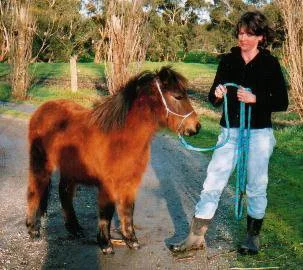
This is our horse, Shetland pony Teddy. It took Michèle and me many sessions to realise she was not 16 hands. 😄