
So many of the issues people have with their horses are in the basic training. I know people who compete at a high level, yet their horse is difficult to catch. Imagine my shock the first time I watched a video of one of the great classical dressage masters having to use a handler to hold his horse still while he mounted. I once had a client who couldn’t load her GP dressage horse into a trailer. At a clinic, a lady brought her very successful endurance horse that, when tied up, would paw desperately. Another rider had a horse that would attempt to bite its owner when he tried to saddle it on the left side, but not on the right side.
In most cases, people think they have a catching problem, a trailer loading problem, a mounting problem, or a pawing problem, or whatever the issue happens to be. But very often that is not the case.
I could write a book about the possible causes of these basic problems, but I won’t. There are enough books on the subject. But I want to propose an idea that I haven’t heard much about.
What if the dressage master’s horse couldn’t stand still to be mounted, not because of pain or a poorly fitting saddle? What if it was because he was stressed and anxious about the work that he knew he was about to endure? What if his anxiety was not because of the mounting, but because he knew he was going to be asked to piaffe at some point during the ride? What if the horse that is hard to catch is not hard to catch, but hates what it knows is going to happen when it does get caught - like being separated from its herd buddies? What if the horse that bites when being saddled only bites because it knows it is about to be ridden by somebody with hard hands using a harsh bit?
When our horse is a little hard to catch, but its arena work is great, we don’t consider that maybe it actually dreads the arena work as the cause of the catching issue. The same could be asked when our horse drags on the lead rope or is cranky to brush, or won’t slow down when being lunged, or has straightness problems when riding, or drifts towards the arena gate when circling.
Most of us see a behaviour we don’t want and think that’s where the root cause is hiding. But it is not always so.
Some people even deliberately try to make their horse’s work something for a horse to hate. They take the adage of “make the wrong thing hard and the right thing easy” to an extreme. A good example of this is when a horse won’t load into a trailer, and in order to make loading the easy choice, they make not loading the impossible choice by running their horse in circles at speed outside of the trailer. They are reinforcing the notion to the horse that working is horrible. Then they wonder why their horse won’t listen to them when lunging before a ride.
If our horses were not troubled by the work we subject them to, so many basic problems would not surface. For many horse issues we associate with catching, brushing, saddling, mounting, picking up feet, head tossing, ear pinning, etc., would not occur. However, if we simply address a problem such as mounting as a mounting problem and ignore the root cause, even teaching our horse to stand still when mounting won’t eradicate the real issue. It is guaranteed that another behavioural problem will surface because the ill-feelings that caused the mounting problem have not been addressed.
I am not suggesting that how a horse feels about the work is the cause of all problems, or even most. But I believe it is not something enough of us consider when trying to solve a behavioural problem. We see the behaviour as the problem and don’t see how our horse feels about the work and what is to come as the problem.
Remember, the work you do with your horse is because you want to do it. You have a choice, but your horse doesn’t. So ask yourself, how do I ensure my horse is untroubled by the work I ask it to do?
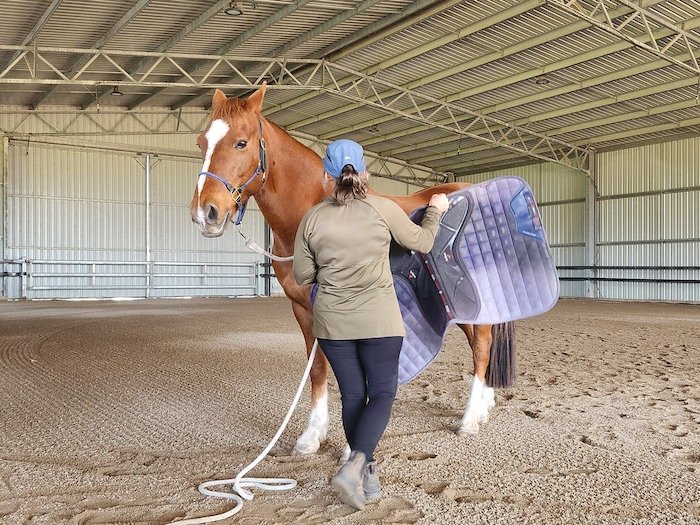
Dougie is a little troubled about the saddle blanket. Why?