
A lady came to a clinic that had never been to one of my clinics before.
She had obviously had some education in groundwork. I watched as she began her lesson by moving her horse around. She asked for a circle, hindquarter yield, change of direction, backing up, etc. The horse was doing ok at going along with the lady, but was clearly only giving a fraction of the effort it was capable of offering.
At first I didn’t know where to begin to help her, but I soon noticed something that stood out like a beacon on a dark night.
I asked, “When you ask your horse to do something, and it responds, what is it you are looking for to tell you to stop repeating that exercise and to start asking for another exercise? What is it that tells you that that’s enough of that thing and now it’s time to ask for the next thing?”
The lady looked puzzled, and finally she said she just did an exercise until she thought her horse had done enough, but she didn’t really know when enough was enough. It seemed to me that she was repeating an exercise for a set number of repetitions or set amount of time, and that was her idea of doing enough.
I decided that the time was right for this very nice lady to get one of my world-famous lectures.
I explained that the purpose of groundwork was to better prepare a horse to be ridden. For example, hindquarter yields are designed to connect the rein (or lead rope) to the hind end of a horse to help it be more correct and balanced during turns and on circles. Likewise, lunging in circles can help build focus and straightness in a horse. Everything we do should be connected to developing a better riding horse.
We want a horse to be better to ride after we have done ground work than before we did it. If that doesn’t happen, the ground work has served no useful purpose. We might as well have skipped the ground work and just started riding from the start.
So if we are going to ground work our horse, everything we do should result in the horse being more focused, clearer, and softer at the end than it was at the beginning. Before moving from one exercise to the other, we should strive to have our horse better. There is not a lot to be gained if our horse is offering the same degree of quality at the end of an exercise as it was at the start.
I explained to the lady that when she feels her horse has made a change for the better in its focus, responsiveness, softness, calmness, etc, then it’s time to quit and go onto a different exercise.
So the first reason to stop an exercise and start another is when a horse has made a good change.
BUT (you knew there was a but coming, didn’t you?)
There is another reason to quit an exercise that may not be accompanied by improvement at all. In fact, the opposite may be true. That is, when a horse is getting worse, and there is no sign that the quality or clarity will improve, we should stop.
I know we are all taught we should not finish working with a horse on a bad note. When we do that, there is the fear that we will have taught the horse a negative habit or somehow damaged our relationship. As a general principle, I agree with this notion. However, it is worth remembering that while things may not be going well, they can always get worse.
If a person is in doubt about how to help a horse improve and there is a danger things may deteriorate, it is best to retreat to try another time. Allowing things to go from bad to worse is a much bigger mistake than not leaving a horse in a good spot. It is better to leave things in a bad spot than a horrible spot.
In cases like this, it is probably better to either move on to something a horse can do easily or put them away for another time to allow emotions to quell. Trying to push through a wall of emotional turmoil is often a mistake.
It is important to keep in mind why we ask something of a horse and know when we have achieved our goal, in order to know when to quit asking. On its own, ground work has no purpose. There are no Olympic or World Cup competitions in ground work. Its role is to help master some other part of horsemanship and make it easier and more brilliant. When that goal is either achieved or it is backfiring beyond recovery, it’s time to stop and try something else. It is important to keep this in mind as we work our horses.
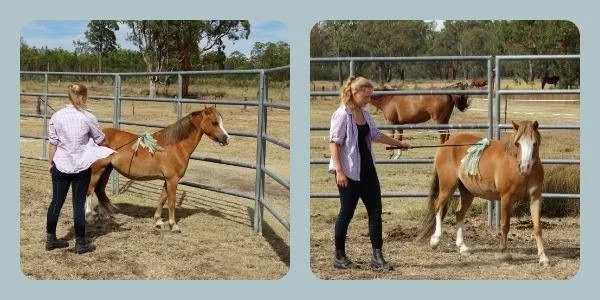
Photo: A few years ago, I had a working pupil from Denmark. Here, Sissel is working our Welsh pony, May. On the left, you can see above how May is worried about Sissel with the flag. But in the pic on the right, May softens and relaxes while Sissel asks May to walk and, at the same time, rubs her with the flag. Things got better.