Why Lunge?
People have different reasons for lunging their horses. Some use it just for exercising and see it as an aid in getting their horse fit. Others use it to take the edge off their horse if they feel he might be a handful when they ride. Some people try to teach their horses to carry themselves and engage their hindquarters better. This usually involves some sort of headgear, like side reins, Pessoa, or chambon, designed to restrict how stretched out a horse can go around the circle.
In the work that I do of starting young horses and helping troubled horses, the main purpose of lunging an additional aid in helping a horse become focused and soft to the commands. This is the same aim I have in everything I do in my training, and lunging is just another part of that. I’ll talk about how I do that a bit later.
However, there is a downside to lunging. Very many people lunge horses in endless circles - lap after lap. I know no quicker way to teaching a horse to tune out and not focus on the work or the trainer. To prevent this, is important that we don’t lunge horses in a routine pattern. We need to engage its mind by lunging in a way that avoids mindless circling.
Lunging Gear
I like to keep the equipment really simple. I generally just use a halter and long lead rope. With a horse that struggles to go forward, I sometimes use a flag or whip to support my body language, but try to wean the horse away from those things as soon as possible.
If I am going to lunge a horse on a circle that is bigger than say 5m radius, I often use a lariat around the horse’s neck rather than a lead rope or lunging line.
A lunging cavesson is a better substitute for a halter. If your horse is to wear a bridle, don’t attach the lunging line to the bit. Use a cavesson or halter under the bridle for attaching the line. Many people clip the lunge line to the bit, but this can cause confusion to a horse for whom you are trying to establish softness to the bit.
I never use gadgets such as side reins, market harborough, chambon or Pessoa. They don’t release the pressure and put the horse between a rock and a hard place. They are purely designed for forcing submission of a head position. In my opinion, they have no place in good horsemanship.
Finally, many people use their voice as part of their equipment. I tend not to do this because I find it is not very helpful. Horses don’t have the ability to understand complex vocalizations – they only have 9 sounds in their own vocabulary! Whilst you can teach a horse to trot when you say “t-r-o-t”, the trot you get is the trot he gives you. If you want a different sort of trot, you have to use body language anyway. So why bother saying t-r-o-t at all? If a horse could understand when you said “working trot” or “extended trot” or “slow trot”, I would consider the voice command to have much more value. I’m not saying there is anything wrong with using voice commands if you want to; I just don’t see the point.
What Is A Circle?
When we think of lunging, we think of a horse moving around us in a circle at a walk, trot or canter. But what is a circle?
By definition, a circle is where the distance (radius) from the centre point to the outer edge (circumference) is equal at any point. This means that for a horse to be travelling a circle, the distance from him to us (the centre) should be the same at any point of the circle. Not only that, but for a horse to be straight (or balanced) on a circle, the distance from us (the centre) and the horse’s shoulder should be equal to the distance from us to his hip.
Most horses are not correct on the circle. Most either fall in or fall out of the circle. Most flex to the outside as they go around the circle. Many lean against the lunging line. The most common cause of such incorrectness is that the horse’s thought is not on the line of the circle (circumference). When he is thinking of being elsewhere, he is also trying to set up his feet to take him elsewhere. When a horse is looking to the outside of the circle, he is thinking that’s where he wants to be, and he leans against the line or becomes counter flexed to the outside.
One of the reasons why lunging in a circle can be so beneficial to your horse training is that when it is done correctly, you are teaching a horse to follow the line he is travelling with his thought. He is learning that you can direct his thoughts. This is the absolute basis of all good horse training.
The Myth Of The Circle
Some people believe that when a circle is correct the inside hind foot is on the same track as the inside front foot. This is only true when the circle is not balanced.
When a circle is CORRECT, the inside front foot moves forward and to the inside. But the inside hind foot travels forward and to the outside. Therefore, if your horse is travelling on a left circle, the left fore steps slightly left as it comes forward, and the left hind steps slightly right as it comes forward.
This happens because the horse has very little ability to laterally flex its torso. A horse has the ability for a lot of flexion from his poll to his wither, but from the wither back, he is pretty rigid. It’s just the way he is built. But it is because of this that in order to balance through a turn, his inside hind foot must move slightly to the outside of the line of the turn to allow his front end to come around the turn.
The vast majority of horses do not turn correctly when we ride because they are thinking outside of the turn rather than on the line of the turn. This is an important principle to remember when lunging.
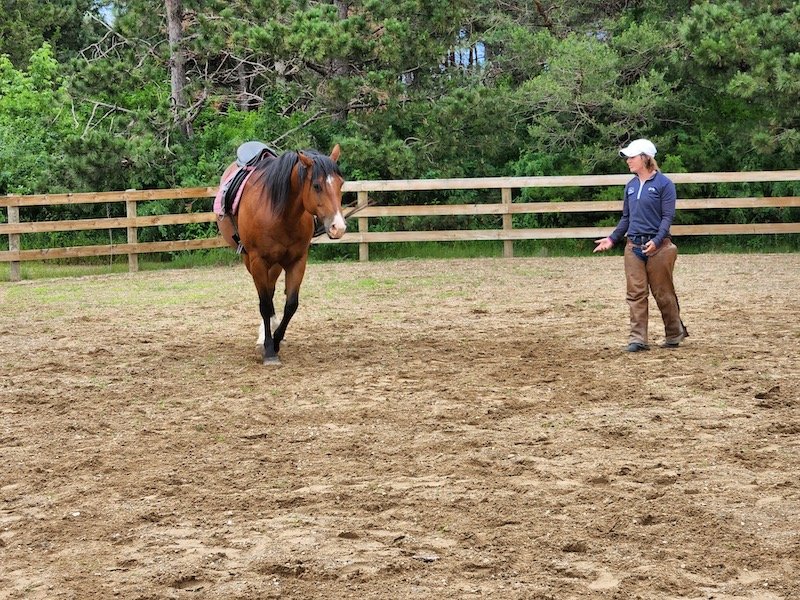
Ellen Kealey forgot her lunging equipment so she had to lunge Jordan without it.