
Very recently, several articles and videos have appeared in my feed highlighting the importance of maintaining contact when riding. I don’t know why there have been so many, but it has driven me to write once again about contact. I apologise if you have heard this rant before.
It is obvious from what I read and view on other sites that contact is almost universally defined as the feel in the reins required to encourage a horse to carry itself in the correct balance and posture. This explanation of contact is largely preached by people focused on the biomechanics of horses. I believe a very different understanding of contact is required.
I should add that contact can refer to the contact of any aid, including the rider’s seat and legs, but for most purposes, contact refers to the feel of the reins.
I define contact as “The minimum amount of feel required to evoke a change in a horse’s thought.”
This definition is very important to understand because without a change in a horse’s thought first, any change in balance, posture, and movement is forced by physical coercion.
When you read the posts I have seen recently, it is clear that physical coercion into submission is exactly what many trainers are looking for. They don’t say that. They believe it is not submission by coercion, but when you push a horse to make adjustments without it first being the horse’s idea, coercion and submission are the only way it can be achieved. And it is never as pretty as the horse could offer if it were its idea.
In the world of dressage, horses are taught to “seek” the contact. In other words, they are trained to push into the reins. In some horses, it is a simple holding of the bit at the end of the outstretched rein. In other horses, it is a bearing down onto the bit – a leaning into the reins. It will differ a little from trainer to trainer. But what dressage people almost universally criticize is to ride a horse on a rein with slack in it. It is widely considered to be incorrect because they think that slack in the rein means no contact, no influence of the rein, and no control.
But let’s again look at the purpose of contact. It is a means of communicating a rider’s intent to a horse, and the correct contact is the MINIMUM amount of rein pressure needed to evoke a change in a horse. So if riding a horse with a rein that is not taut can achieve both these criteria, then the rider must be using the correct contact. In fact, I would argue that to ride such a horse with more rein pressure than that is incorrect contact.
The purpose of riding – any sort of riding – is to achieve as close a unity with a horse as possible. To me, this means that the means of communication we use to talk to our horse should be quieter as we approach that unity. The more advanced a horse becomes, the more subtle our aids and the less pressure we need to transmit our intent. It would seem that the ultimate goal of every rider would be to have a horse that can be directed by the smallest change and the least amount of pressure. It just seems logical, therefore, that a horse that can be ridden correctly with slack in the reins is more advanced than a horse that requires anything more than that in order to be correct.
But I want to emphasize the importance of being ridden CORRECTLY. Correctness is key here. I would not want to sacrifice correctness just so I can say my horse does a canter pirouette on a loose rein if it is a poor canter pirouette. If taking a stronger feel on the reins would help my horse find a better quality canter pirouette, then I would. There is nothing to be gained by letting a horse flounder in mediocrity so you can ride on a loose rein. This is one reason why I don’t like most of the liberty riding that I see. Most horses ridden at liberty perform very poorly, and correctness is forgotten just for the sake of showing that the horse can be ridden without a bridle. To me, that has no merit. And I say the same thing about contact. There is no merit in riding a horse with hardly any rein pressure if he needs more rein pressure in order to help him be correct.
Contact is not one thing. Contact is the minimum amount of rein pressure a rider needs to evoke a change in a horse’s thoughts. On some horses, that might be 10kg, and on others it might be the weight of a carbon atom. Both are correct for those horses. But to ride a horse with a stronger feel on the reins than is needed is incorrect use of contact. Likewise, too little feel on the reins to help a horse change his thought is also incorrect use of contact.
I think to argue that a horse that can be ridden correctly with slack in the reins is either evading the bit or falling behind the bit is to forget the purpose of contact. I believe once you appreciate what contact is and why it is needed, that idea seems backward and counter to what our ultimate goal should be in riding. I believe it comes from a reading of the books and not a reading of the horse.
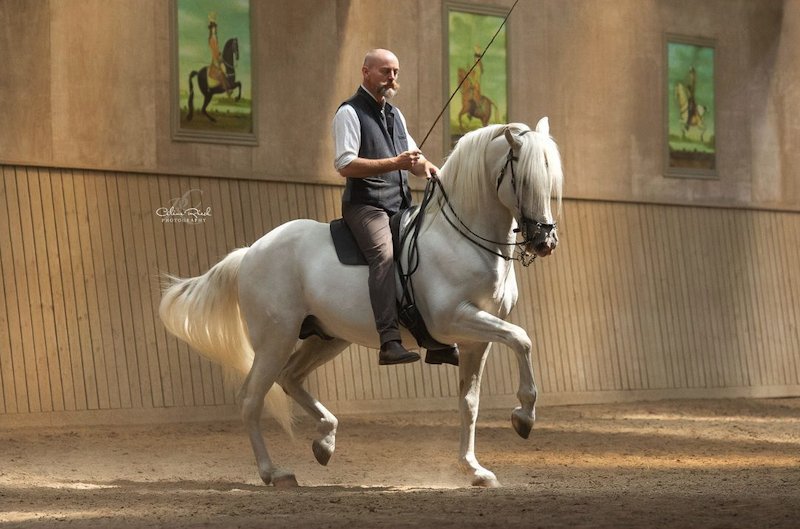
Bent Branderup from the Academic Art of Riding. Some might argue that the rider has insufficient contact because there is slack in the reins. They would be wrong in my opinion because there is still enough contact to communicate the rider’s intention to the horse’s mind to create a change of thought.