
How do you know if you have a good relationship with your horse?
We all want to think that we have a wonderful relationship with our horse. If our horse does pretty much everything we ask of it, we take that as an indication that we get along well together. If our horse does not seems okay to be caught, load in a trailer, steady for the farrier, doesn’t shy much on a trail ride, engages its hindquarters when we ask for collection, does not run off when we take it back to the paddock, it gives us reason to boast that our horse enjoys our time together and we are good mates.
I’m sorry to disappoint you, but I think those things are the easy part of working with horses. The reason why we domesticated horses is that getting them to do stuff is relatively easy if you have a few basic skills. The hard part is to get horses to feel stuff while they are doing the stuff we want.
When somebody wants to show me how well things are going with their horse, they’ll inevitably take their horse through a litany of impressive movements and exercises they have focused on in their training. I look for the ‘giveaway’ signs, the horse’s emotional state that allows me to gauge the true nature of the relationship between horse and owner. Often, that gives me enough to get a solid impression.
However, when I point out problems that are apparent to me, many owners don’t agree and will argue with me. It’s not easy to accept criticism when we believe we have a brilliant relationship with our horse. We insist that the quiet transition, the light contact our horse offered, or the balanced circle is enough proof of the brilliant relationship we have with their horse.
To prove my point regarding the trouble in the relationship, I might ask the owner to ask the horse to do something the horse has never done before. For example, the horse might load on and off a trailer quietly and calmly. But to test how good it is, can the horse walk on only halfway, stop, take one foot back, stop, walk 2 steps forward, stop, shift its weight to a different front foot, wait 15 seconds, walk off 1 step at a time? This tells me how strong a connection it has with the handler and how much it is listening.
The test is not whether the horse did everything correctly. The thing that tests the relationship is if the horse has a ‘try’, or does it put its effort into repeating the old pattern of loading and unloading? Does it ask the owner questions, or does it check out? Does it get upset, or does it use its problem-solving skills?
I watched a video of somebody working 6 horses at liberty. All the horses were polite and obedient and did everything asked of them without argument. But I felt there was tightness in them, and none of the horses checked in with the trainer or asked the trainer a question. I was sure they were repeating a well-rehearsed pattern. The comments overwhelmingly expressed awe and astonishment at the horses and their relationship with the trainer. But I would like to know what would happen if the trainer repeated the routine with all the horses but horse no. 4. Would it be as flowing and impressive? What if horse no. 4 was asked to do a different routine that it had never done? What if horse no.4 was asked to walk while the others cantered? What if no. 4 was asked to switch positions or trot in the opposite direction to the others?
Again, the test of the relationship is not in how well horse no. 4 trotted in the opposite direction. The real test is in how well horse no. 4 felt and how it emotionally handled something new and unfamiliar. Would it try or would it give up? Would it ask questions or would it shut down?
If you really want to know about the kind of relationship you have with your horse, don’t fixate on how well it does something in its training. Notice how it reacts and feels when you change what it thinks it is being asked to do. That’s the real test.
We learn a lot more about our horses and our training not by what our horse is doing, but by how it feels and responds when we interrupt what it is doing.
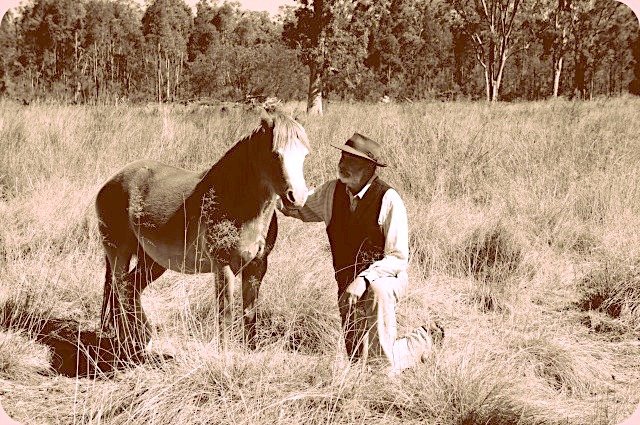
Our Welsh pony May, is liberty training me to give scratches.