Every decision a horse makes is driven by emotion. That means every behaviour is driven by emotion. The only exception is when a response bypasses the brain, as in a spinal reflex (e.g., your leg jerks when a doctor taps your knee). But spinal reflexes are very rare in horses.
Even how they respond to physical pressures like hunger, a mosquito bite, or a sore back is driven by the emotions those pressures provoke. When a horse is exposed to discomfort, it is not responding to the physical discomfort, but the emotional discomfort that the physical discomfort sets off.
At first, you might think that sounds wrong. Surely, a horse bucks because its back hurts? And of course, yes, the back pain is the source of the problem, but the decision to buck is a reaction to the troubled feelings the brain processes, not the back.
Why do I bring this up?
Most people believe they know their horse. They are convinced they can read the signs when their horse is happy and when it is not. But in my experience, people are generally only good at reading the obvious signs of trouble in a horse. They see he is not bucking and take that as a sign of a happy horse. They sometimes see muscle tension, rushing, tossing of the horse’s head, foot stomping, resistance to the aids, etc. They observe or feel these symptoms and correctly conclude their horse is not comfortable or happy. However, very few people excel at reading the subtle signs. The list of subtle signs is huge and varied. Each horse has its own secret language to tell you what they are feeling. And even those signs can vary in meaning moment to moment (let alone horse to horse), depending on context
Just to give you an example of how complicated it is to read the emotions of a horse (or any species with a complex mind), when my horse blinked, it told me something. I also noticed it blinked 3 times fast and 5 times slowly. That tells me something else. I also noticed the blink of the left eye was harder than the blink of the right eye, and that tells me a different story. Then I noticed the blink was accompanied by the tail hanging more to the left, and that adds a totally different piece to the puzzle. When my horse did that, he also shifted a small amount of weight from the right hind foot to the left one, and that told me something I had not yet considered. Then my horse yawned, but no air passed, and that heralded a total shift in its thinking.
The process goes on and on and changes from moment to moment. Nothing my horse does ever means nothing. And the blink he gave 10 seconds ago tells me something different from the blink of 5 seconds ago because both the way he blinked and the context of when he blinked changed.
To add to the problem, if another horse displayed the exact same behaviours as the first, there is a strong chance they would mean different things.
It’s like when I ask a friend how their day was, and they reply “fine”. The tone of their voice when they say “fine” and their energy, and how they look at me, and what they do next, all tell me what they really meant when they said, “fine”. Sometimes when they said “fine,” it would mean they had a good day, and other times it would mean they had a bad day, and they didn’t want to talk about it. There is much more information to be gained by how they said “fine” and all the subtle changes in body language than from just accepting the dictionary meaning of the word as an indicator of what they meant when they said “fine”.
Most people gauge how their horse is feeling by how obedient their horse behaves. We think a horse that offers a forward trot, but not rushy and not lazy, is a horse that is happy to trot. That might be true. But did we notice where it was looking? Did we notice his balance in the transition from a walk, and which diagonal he used to start the trot? Did we pick up if our horse was tracking straight? If we interrupted the trot, would our horse be soft and mellow? If we lost our balance for a moment, would our horse notice, ignore us, or make an adjustment and ask if we are okay? We see a horse that is doing what it is told without distress and without argument as a happy horse. The entire competition world is founded on that belief. And sadly, much of the horsemanship fraternity has also succumbed to that view (both -R and +R approaches). But it is not a reliable way of interpreting our horse’s emotional well-being.
There are several ways to read your horse’s emotional state that are beyond relying on how obedient it performs. I devote a huge amount of my attention at my clinics, trying to help people be aware and understand how a horse is feeling and what they are thinking. This includes how to influence its thoughts and emotions. How to change ill-feelings into comfortable feelings. And how to change ideas we don’t want our horse to have into thoughts we can both agree on.
It’s rewarding to see the changes in both the students and their horses. It’s what I like most about my job. Helping people understand how to turn their horse into a friend that is happy to try its best for them is very rewarding.
It’s hard to be good at reading the thoughts and emotions of horses. In contrast, it’s relatively easy to train horses to do things. But it is very hard to get them to think and feel okay about the things we want them to do. Most people don’t recognise the difference. That’s why it is not for everyone. However, I believe that for anyone who wants to prioritize how to best get along with their horse, I don’t see any other way. For me, it’s the contrast between a person who likes t ride and a person who loves horses.
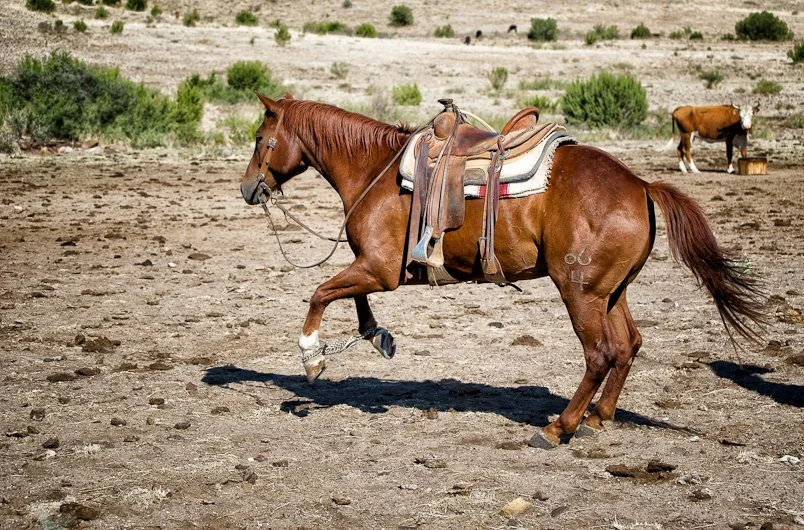
This is an example of training a horse to be obedient and not how to feel okay about what it is being trained to do.