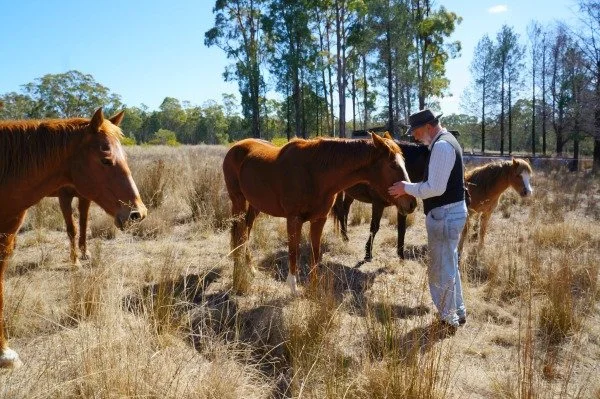
I remember watching my horse, LJ, walking chest deep into a small dam (pond) in his paddock to eat the reeds and splash water over his flanks. I also remember the argument he and I had a few days later when I tried to ride with him into the same dam. My thoughts at the time were something like, “What the hell! You had no problem a couple of days ago. Why are you being such a pill now?”
Then there was the time my horses were grazing lazily in the long grass, happily sharing their space with about a dozen or so kangaroos. It was like a family gathering at a Christmas buffet. But contrast this scene with one week later, when I rode Riley past a group of kangaroos drinking from the dam in his paddock. He walked tentatively with eyes wide and snorting at the slightest move made by the maniacal marsupials. He was sure this band of cutthroats was plotting to end his life with their long, powerful tails and the knives they carried in their pouches.
So what changed that made the dam and the kangaroos a threat that they weren’t just a short time before? Of course, it was the fool in the saddle. I was the common factor that created the trouble.
When horses are left to their own devices to negotiate a challenge, they know exactly how to investigate it in order to establish and mitigate the risk factors. When a horse sees something it is not sure about, it dons its Sherlock Holmes deer-stalker hat and cap, lights a pipe, and goes about asking all the right questions about the object to get the answers it needs to determine if it is safe or unsafe. It knows what criteria it needs to know to satisfy the conditions for safety and comfort, so it sniffs, approaches, and retreats, pokes and prods in a way that gives it the answers to the very important questions. When it has all the answers, it then knows if things are okay or there is no way it is getting close to that death trap.
However, when a human enters the picture, things change. We interrupt the normal process a horse goes through to ascertain if something is okay or not. The horse no longer asks the questions it would ask in the way it would ask, and is no longer on its own time frame. We have our own way of problem-solving and tend to impose the way we process problems on our horses. We often don’t do it the same way that makes a lot of sense to our horse. We also don’t tend to have the same degree of patience to investigate the issue as our horse does, and we hurry the evidence gathering, which exacerbates the horse’s worry. We push our horses into submitting to a situation that they would never do in such a hurry if left to do it their way.
It’s like the horse is the slow and methodical police officer gathering all the evidence, and we are the cop in a hurry just wanting to beat the suspect into a confession.
Even if we allow a horse all the time to investigate a problem, we still restrict how it goes about it. We mostly do this by limiting a horse’s options to walk away from the problem or by setting a time limit on how long he has to figure it out his way.
In an ideal world, we would allow horses to problem-solve in their own way. But many times this is not practical, especially if you are a professional trainer with the owner’s expectations of taking home a perfectly angelic horse in 30 days. Even the amateur horse person has to impose restrictions on the number of choices they give their horse when a problem arises. If you need to get your horse home from a show and it won’t load into the trailer and you are running out of daylight, sometimes things don’t go according to the horse’s preferences.
But this is the principle we need to always keep in mind. If we continue to impose our will on a horse in a way that doesn’t feel okay to our horse, we are guaranteed to build mistrust in the relationship. That is, without doubt, a certainty. The mistrust and skepticism in our ability to keep him safe will grow with each episode, even if the obedience improves. Which is exactly why a horse that will happily graze alongside a mob of kangaroos will baulk when we try to ride him towards them.
The problem is not the water or the kangaroos or what we think it is. The problem is the holes in our relationship with our horse. The problem is one of a lack of confidence and mistrust in being directed by us into less-than-ideal situations. The solution is to figure out not how to make a horse do something, but how to help a horse feel something when we try to direct his thoughts. The doing part is simple and easy, but the thinking and feeling part is a lifelong pursuit.