A while ago, I was teaching a student at a clinic how to move a horse’s forehand across. The rider questioned my suggestion that she not use her outside leg against the girth to encourage the shoulders to step away from her leg. Considering the greenness of her horse and the lack of understanding of how to follow the inside rein or yield off a rider’s leg, I felt that using her outside leg would complicate and muddy the clarity of moving the forehand. My explanation did not quell her confusion, so I asked her why she wanted to use her outside leg. Her answer was simple and echoed the thoughts of many riders I encounter. “Well, that’s how it is supposed to be done!”
Everything the rider had read and been taught by instructors told her that to move the shoulders across, a rider should apply outside leg against the girth. So why would I tell her otherwise? Had I lost my mind? Did I not understand the basic rules of moving a horse’s forehand as laid out by all the experts?
I hadn’t lost my mind, and I do understand the teaching principles of past masters.
When I was about 14 years old, I read Podhajsky’s classic book “The Complete Training of Horse and Rider” from cover to cover. I read it many times. I read that if I did ABCD, a horse would canter on the lead that I wanted. Then if I did EFGH the horse would swap and canter on the opposite lead. Fan-bloody-tastic, I thought! I tried it. It didn’t work.
Was Podhajsky lying? Was he an idiot? Was I a terrible rider? It turned out none of those things were the reason my horse didn’t canter on the correct lead or change leads when I asked (well, maybe the last reason was a dim possibility).
What I didn’t know and what the student at my clinic didn’t understand is that the books of esteemed masters and the instruction we both had received were not talking about the horses either of us was riding that day. Their wisdom was intended for another horse that had excellent training in following the feel of a rider’s reins, seat, and legs. Neither my horse nor my student’s horse fit that category – YET.
I sometimes read on riding forums the sage advice of members that a horse needs a little more inside leg or the straightness problems of a horse stem from a rider’s shoulders not being perfectly aligned or a forward problem a rider is struggling with can be cured if only they looked more ahead instead of down. The advice given could be the right advice IF the horse understands those things. But when a rider or trainer receives such instruction, it presumes the horse has also received the same instruction.
My point is that the rules of riding and the rules of training are not rules. They are recommended guidelines for the education and riding of a horse. But they are not rules, and they are almost meaningless if a horse has not been educated in those rules. Consider, for example, the way dressage teaches you to ride a corner with inside leg and outside rein so a horse carries itself balanced and straight around the line of a corner. A horse does not automatically know what to do when a rider applies inside leg. If they are on the green side of educated, applying the inside leg will almost always indicate to a horse they should go forward with more energy. Yet riders interested in keeping to the rules of most dressage instruction will bring their horse home from the horse breaker and start riding the corners and circles with their inside leg applied. Then they have to get stronger on the reins to ensure their horse doesn’t rush the corner. What the hell is a horse to think? But that is how we are taught in dressage to ride a corner. No instructor ever told me to use inside leg on one type of horse, but not on another type of horse. It was always “inside leg to outside rein” on every horse, irrespective of how far along it is in its training or previous training experience or temperament, etc.
A horse does not give a damn about the man-made rules of riding and training. I could teach a horse to perform a beautiful shoulder in while ignoring every aspect of how a rider is supposed to sit and apply the aids correctly. It may make it easier for a horse to carry me through the shoulder in if I align my centre of gravity with the horse’s centre of gravity. But my poor seat does not make it impossible to teach my horse to perform a beautiful shoulder in.
Avoid trying to make every horse look like a round peg to fit into round holes. Some horses are shaped like square pegs, or rhomboids, or hexagons, or triangles. It takes work and training to make them into round pegs so that one day they will be able to be ridden in accordance with the rules of the experts. So don’t ride them like they are finished and fully educated horses that fit the mould of the finished and educated horses the experts are talking about. It only confuses them.
Ellen Kealey (https://www.facebook.com/ekhorsemanship/) sent me a saying from the Buddhist monk, Kukai that I feel is very apt for this post. I paraphrase, "Don’t try to emulate the old masters. Instead, search for what they were seeking."
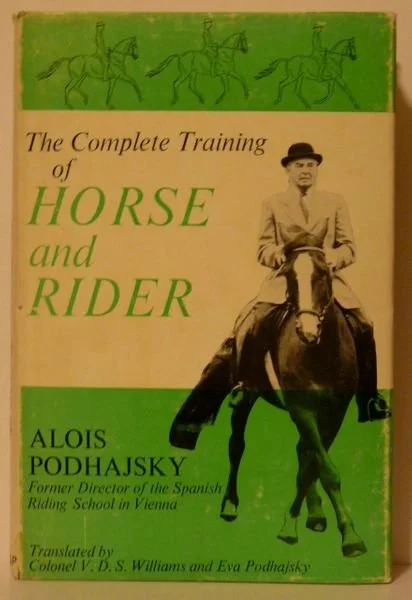
Alois Podhajsky was a former director of the Spanish Riding School and published The Complete Training Of Horse and Rider in 1967.