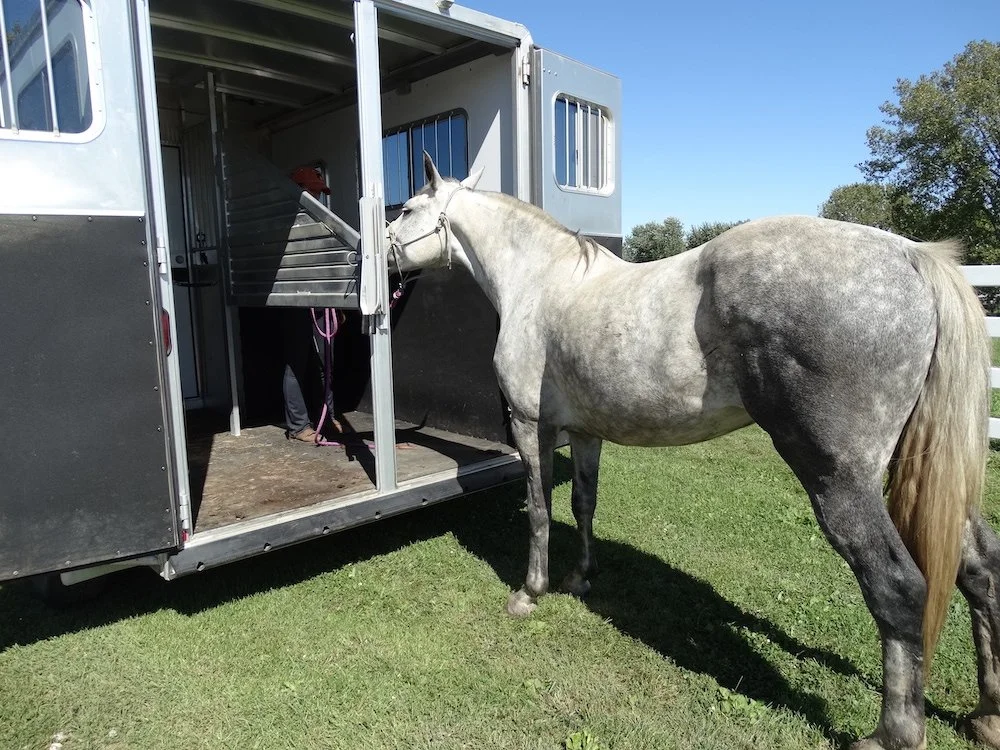
Out of curiosity, I searched YouTube to find out how many videos were uploaded explaining how to load a horse that refused to load. I wasn’t able to determine a precise number or even a good guess. The AI bot I asked (YouTube won’t give a number) estimated the number of videos was in the hundreds.
So if you are seeking help with a problem like trailer loading, saddling, transitions, catching, etc., out of the hundreds of videos to choose from, how do you know which method to try? Obviously every method worked for the horse in the video. But does that mean every method will work for your horse too?
I guess I should first define what I believe it means when I say a method “works”. To me, for a method to work, it has to do more than create an obedient response for my horse. It has to address the concerns of the horse that make going along with our idea so difficult. For a method to work, I want it to create a mindset in a horse that makes them comfortable and willing to work with us. Using methods that just make a horse obedient is not good enough for me.
Now that I have cleared up what I mean by a method “working”, how do I choose a method that will give me the outcome I want?
The answer is obvious if you think about it.
Choose the method that best addresses and changes the real cause of the problem. This usually means addressing something far more basic than the problem itself. For example, a horse may not load into a trailer because something as basic as the way it leads is not good enough for a challenge as big as trailer loading. Or maybe it does not trust you enough to be wedged into a confined space. Or maybe the backup is a problem. I can’t tell you how many loading problems I have solved by simply teaching a horse to lead brilliantly.
Similarly, tying up problems, saddling problems, picking up feet, movement and balance problems, and whatever issue you can think of all stem from problems different from the issue that is bugging you about your horse.
A few years ago, a student wanted help with her canter lead changes. I had started her horse for her 4 years earlier. Since then she had been working with an instructor, and I had not seen the horse since. I watched her riding for a little while. I could see the problem was related to a poor connection between the inside rein and the hindquarters; there was a brace to the inside rein.
I suggested she practice hindquarter yields at a walk, and then at a trot. She was confused by this because we had done this exercise with her horse 4 years earlier when it was being started. I told her, “The quality of hindquarter yields that you need when asking for a lead change is much higher than the quality you need to make your horse safe to ride.”
I rode the horse for about 10+ mins and worked on the hindquarter yields. It solved the problem, and the canter lead changes came together without specifically working on lead changes.
The owner later told me that working on the hindquarter yields also helped her horse be more balanced with her circles and straighter in her lateral work.
So often we see a problem as the problem. But, in reality, the problem we see is often only a symptom and not a cause. Your horse refuses to ride through a puddle. But when you watch it wander through the paddock, it walks through puddles all the time by choice. Clearly, a fear of puddles is not the problem, yet we treat the issue like it is a puddle problem.
When you flick through the internet looking for a method to teach your horse something or choosing a trainer to work with, ask if the work is directed at solving a symptom or a gap in the basics that comes before the symptom.