
When you bring up the topic of trailering problems, most people immediately think of a horse that won’t load into a trailer. But there is a percentage of horses that are fine to load, but terrible at travelling. Broadly speaking, I categorize them all as “scramblers”. Not because they all exhibit the same behaviour, but because the cause of the unhappy traveler stems from the same place.
The sort of behaviours that I classify as scrambling include running up the walls of the trailer (see photo), weaving, stomping, kicking, striking, rocking back and forth, and leaning against the trailer wall. These are all expressions of the same problem. No matter the behaviour, it is all derived from anxiety associated with the insecurity of standing on an unstable, moving platform.
Scrambling in a trailer is either one of the simplest or most difficult problems to resolve.
My experience tells me that the problem of a horse’s balance in a trailer is a really common cause of scrambling. There are only two reasons why a horse might have trouble balancing in a trailer (assuming the horse does not have a neurological problem). The first reason is bad driving habits by people, and the second is trailer design and setup.
I don’t want to go into detail about driving habits except to say the people need to be super aware that any change in speed or direction needs to be seamlessly smooth. Most people know this, but some people forget that when towing, the trailer is several metres behind the position of the car. For example, when cornering, people will accelerate the car after it comes out of the corner and is pointing straight. However, the trailer may still be coming around the corner when they accelerate, even though the car is heading straight. This inevitably causes a horse to lose balance because of increased centrifugal force. So people should be aware of balance issues within the trailer they are towing, and not so much in the vehicle they are driving.
But regarding trailer design, let me state that horses have a distinct preference. Analysis of indicators of stress in horses has shown that horses are much more relaxed when travelling at an angle and facing backward. I’ve seen this myself when horses are allowed to be loose while travelling in trucks. They almost all face backward at an angle. I really think aligning themselves in this way allows horses the best opportunity to find their balance and smoothly adjust to the motion of the trailer.
The next least stressful configuration for a trailer is to have a horse standing at an angle and facing forward. And the least comfortable option is a straight load trailer, which also happens to be the most common form of trailer design in Australia.
In my experience, it is unusual for a horse to scramble when travelling in an angle load trailer. The couple of times I have witnessed this is when the length of the trailer bay was too short for the horse, and the horse risked colliding with the wall with its face. In both cases, the problem was overcome by changing the angle of the bay (through re-positioning the divider) to make the bay longer and give the horse more freedom to choose how it wished to stand.
There is no doubt that straight load trailers are the worst culprits for inducing scrambling behaviour. Being forced to stand aligned in the direction of travel seems to make it more difficult for a horse to balance and adjust to changes in the angular forces. This creates both a fear of falling over and a lot of muscular effort to stay upright. So the stresses are both physical and psychological.
The easiest solution to scrambling is to replace your straight load with an angle load trailer. It’s an expensive solution, but it has helped overcome the problem in every case that I know where the trailer has been replaced. There are alternative straight load trailers that allow a horse to spread its legs wider for better balance, but I have no experience with these.
However, if you are stuck with your straight load trailer and your horse shows signs of being a scrambler, there are a few things you can try.
My first option has always been to either remove the divider or fix the divider so that it is at a diagonal angle. This turns the trailer bay from straight facing to angled facing. You might also have to alter the side that you tie your horse. In Australia, we drive on the left side of the road and tie our horses to the left side of an angle load; however, this makes no sense because it means that most of the horse’s weight is on the left side too (60 percent of a horse’s weight is on the front end), which is the low side of the camber of the road. It is both safer and generally more comfortable for them to be tied to the right side of the trailer to coincide with them facing the high side of the road camber (i.e., facing uphill).
Sometimes, removing or changing the angle of the divider makes a huge difference, and a horse will settle nicely after a few rides. But sometimes, it makes no difference. The reason can be that a horse is so fearful of standing on an unsteady platform that it freezes and is unable to move its feet to find a good position to balance and feel comfortable. On the few occasions that this has happened, I discovered it helped to stand in the trailer with the horse (if safe) and teach the horse to yield its feet. Basically, I did a little ground work while in the trailer. When the horse was free and comfortable about giving to my feel with its feet, I had somebody drive slowly while I again asked the horse to move its feet. After I’ve had success with getting a horse to relax and unlock its feet, I have left the trailer and repeated the process with the horse in the trailer by itself. I have to admit that I have had success with this approach on about half the horses, and the other half it seemed to make no difference. However, if you are going to try this tactic, please be careful because being in a trailer with a horse on the verge of panic is obviously extremely dangerous.
If you have a straight load trailer and a horse with a scrambling problem, a side effect is that it becomes almost impossible to be able to trailer two horses simultaneously because of the extra space needed to spread the horse’s legs.
I believe other factors go into determining a horse’s comfort in a trailer – trailer size, divider design, suspension, airflow, windows, noise, light, etc. But I can’t cover these topics here.
Suffice it to say that scrambling is a problem that I don’t have all the answers to. The only reliable success I have had is transporting a problem horse in an angle load trailer or truck. Perhaps some of you have discovered a novel and workable solution for this issue.
To me, the real mystery about scrambling is that there are not more horses suffering from the problem. It is a constant reminder of how amazing horses are that they walk into a tin box on wheels in the first place!
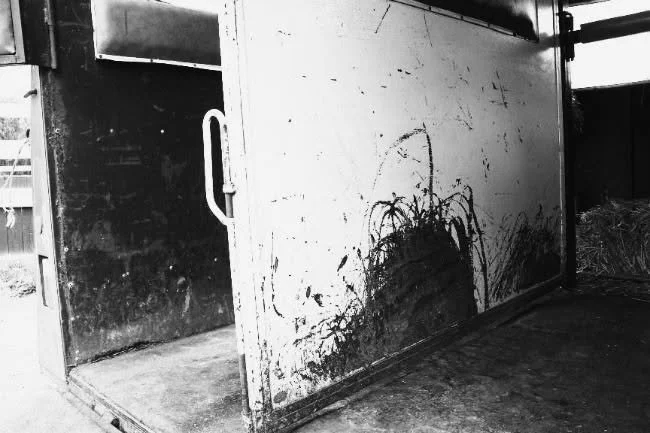
This photo shows the telltale signs of a classic scrambler that climbs the wall and/or divider of a trailer.