Several years ago I was teaching a clinic in Montana. At dinner, I talked to the host about the lesson I gave her earlier that day. I told her I was really happy with the changes she made and how she stepped up to help her horse feel a lot better and perform a lot better. It was a terrific lesson.
Jean said, “Well, I didn’t want to get a talking to.”
“What do you mean?” I asked.
“Last year you gave me a real talking to. You told me I was doing the same thing I was doing the previous year, and what was it going to take for me to get serious enough to make some changes? You told me I had all that I needed to step up and help my horse, and it was time to stop making excuses. It was a real wake-up call for me.”
I didn’t remember the incident but apologized if I was too harsh. But Jean explained that although at the time she felt bad, she also knew I was right, and it was the best thing I could have said to her. She was glad I said the things I said because it changed everything for her and her horses. The proof of that is in how well Jean worked in the clinic.
Most of the time, a clinician does not know their students well. This makes knowing the buttons to push and not to push for each student very difficult to determine. Some students need to be handled with care because to do otherwise would paralyze them from making any progress. Other students want brutal honesty and equate positive adjectives with patronization. But most people want and need a mixture of honest criticism and gentle praise.
For most of us who teach riding and horsemanship, what makes us qualified for the job is that we are good horse people. But almost none of us are trained to teach people. We just teach horses. Yet, what good are we as clinicians or instructors if we are lousy teachers of people? I am much more valuable to my students if I am a brilliant teacher than if I am a terrific horse person but a terrible teacher.
At another clinic a few weeks ago, a couple of students were relating their experience at a clinic where the clinician did nothing but spout sayings that were better suited to being on a wall poster with a photo of Churchill or Einstein – something wise like “if you always look down on people, you’ll get a sore neck.” The clinician was known for this and obviously felt that was good teaching despite the esoteric nature of his wisdom.
Then there were stories about clinicians who would say nothing, or the ones who were prone to verbally abusing students for asking a question or misunderstanding an instruction. In contrast, we probably all know a teacher who spends most of their time telling their students how great they are doing and rarely shares any fault-finding.
I think the best teaching is honest. Few people seem to learn much from teachers who don’t instruct and only praise. And even fewer learn from teachers that are aggressively blunt and make them feel undeserving of their time. I believe a good teacher can always find something good in what a student is doing, but also not step back from pushing a student to do better.
I see the way we should try to teach people is very similar to how we approach teaching horses.
I believe that teaching people is similar to teaching horses in that when they are struggling, I need to be very supportive and be happy for the small victories. But when they are doing it easily, I will push the boundaries and express criticism for half-tries. Some people like instructors who are only very supportive and rarely critical, but often there is little or no progress because they are not pushed. In my view, it is possible to encourage a student while at the same time pushing them to do better.
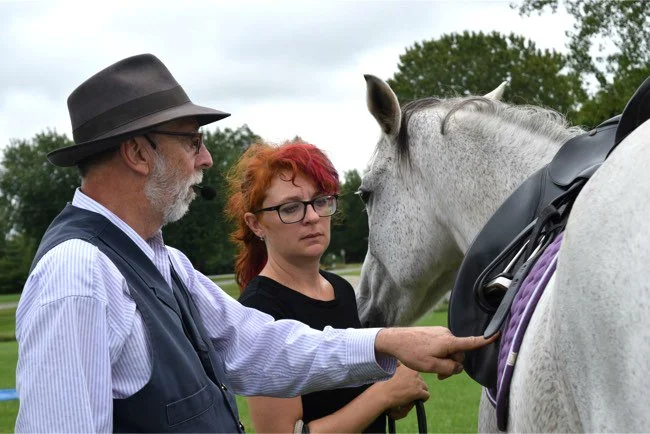
This is an example of my brilliant teaching skills.
Ross: Charity this thing is called a saddle.
Charity: Master, you are so wise!