I’m going to discuss a topic that causes a lot of confusion and quite a bit of argument whenever it comes up at clinics – which is quite a lot.
The idea I want people to think about is that, when introducing the concept of lateral movements into the training, a rider does not use their legs to support directing a horse.
Please understand that I am talking here about teaching the early stages of lateral movement. It is different for the stages that come after.
Some of you who have attended my clinics will know the look of total confusion when I say to someone, “Now we are going to start to teach leg yielding, but don’t use your legs.” It might be any lateral movement such as hindquarter disengagement, forehand yielding, side passing, shoulder-in, etc – it doesn’t matter. Whenever I begin to teach a horse these maneuvers, I do not use my legs to direct the sideways movement. My legs are applied only for encouraging forward movement, not lateral movement.
I want to be clear here. I am talking about when I first begin teaching these movements: I don’t use my legs and only use my reins and seat to direct the horse. However, when a horse is relaxed, soft, and accurate in performing lateral movements without the need for a rider’s leg, then I will teach them to yield to my legs.
I’m sure this goes against what many of you have been taught and believe, and you probably think I am mad or making a joke. But I believe I have good reasons why I approach the teaching of lateral movements in this way.
So what are my reasons?
The first reason is that I want to teach my horse that the reins can influence their thought to move the front end and the hind end separately from each other AND in unison. It’s one of the most basic functions of the reins to be able to do this. That’s what all those hindquarter disengagements and forehand yields that people practice over and over are all about. Their purpose is to teach the horse that the reins connect the mind to direct the front and back end of the body and move their feet in any way the reins indicate.
With this in mind, teaching a horse to perform a lateral movement by just following the feel of the reins reinforces this most basic function. It is something that is largely missed by most people and is one of the major causes of resistance to the reins and a lack of straightness. By ensuring that the reins alone can direct a horse in any way we desire, we are on the road to teaching them softness.
The second reason is that reins provide clarity to a horse. When a rider first attempts to apply the inside leg in an effort to convince a horse to yield sideways, virtually every horse will want to go forward. No horse has ever been born that innately understood that pressure from just one leg means to move in the opposite direction. Yet, people are taught to apply inside leg and outside leg in order to get horses to yield to the side away from those legs. Usually, there is no preparation beforehand to teach a horse that they are to move away from the leg. It’s just expected that if the rider does it enough, the horse will understand. It’s in books, magazine articles, videos, and riding classes. How many times has a rider been told to use inside leg when riding a corner? How many times has a horse been taught to yield away from the inside leg as a prerequisite to telling the rider to use inside leg when riding a corner?
In all the years I trained with riding and dressage instructors, nobody ever taught me how to teach a horse to yield away from the inside leg. Despite being taught by some of the most highly regarded coaches in the country at various times, not once did somebody take the time to help me teach my horse how to move away from the inside leg. Horses seem to be just expected to know it.
I discovered a long time ago that I did not need my legs to direct a horse in lateral movements like shoulder in and shoulders fore. I found that it was possible to do this just with my reins, and my legs' only purpose was to ensure the horse kept moving or had energy in its feet. For this, I could use my seat and both legs if necessary. Even when working on the ground, one doesn’t need to use a whip or hand on the side of the horse to encourage lateral movement – just the feel on the lead rope or the reins when standing beside the horse is enough.
I also discovered that when it came to teaching a horse to move away from my leg, it was a very simple matter to transfer my rein aids to my leg aids. I just had to first ask with my legs, then support with my reins a moment or two later. First my legs, then my reins. Again, first legs, then reins. I repeat it again and again. After several repetitions, when I apply my leg, the horse yields way before I begin to support with the reins. Voila! My horse is learning to yield to my leg. In this way, by first teaching my horse to follow the feel of the reins, it takes a lot of the confusion out of learning to follow the feel of the leg.
What I also learned is that most people do it like I do, except they don’t know it. By that I mean, most horses that come to my clinics actually move laterally in response to the reins and ignore the inside leg despite the fact that riders have been taught to use their inside leg. For example, say they want their horse to execute a shoulder in or a side pass or just a circle. They use their reins to shape the lateral flexion and then apply their inside leg to direct the feet. Or at least that’s what they think is happening. But in reality, it rarely is like that.
When a rider indicates their skepticism at my claim that their horse does not listen to their inside leg, I ask them to drop the reins on the horse’s neck and fold their arms. I then tell them to use either the right leg to ask their horse to move to the left or the left leg to have the horse move to the right. In almost 99% of cases, the horse just moves forward and not to the side. I can think of only 2 instances where the horse yielded away from the rider’s leg. This surprises most people because they were convinced their horse did yield to their inside leg. But the truth is that the horse’s leg yield, or shoulder in or haunches in, etc were actually due to the horse following what the reins were telling it, not the legs.
So how do you use the reins to direct lateral movement? It depends on what sort of sideways movement you want. But for example, if I were to ask for movement away from the bend (eg leg yield), in brief, a rider should use the inside rein to create the lateral bend and the outside rein (and outside seat) to guide the direction of movement and to regulate the forward movement. It is virtually no different from what most people do anyway, but just take out the pressure from the rider’s leg.
It is important that the forward movement is slowed down when teaching so that the energy can be directed laterally. In the beginning, the more the forward movement is slowed down, the easier it will be for a horse to understand that his energy is to go to the side.
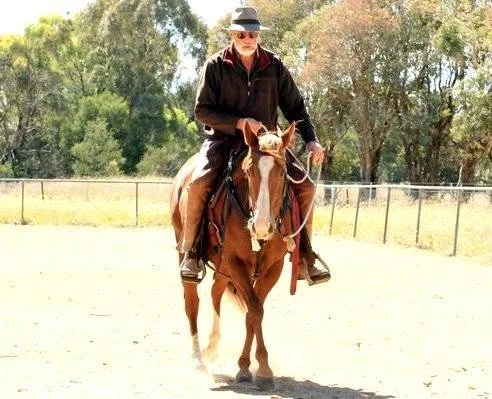
In the photo, I am working on teaching a softer leg yield to a horse at a clinic. My inside rein is bending the horse to the right, and my outside rein is directing his thought and feet to the left. Notice I am not applying my right leg.
A horse must learn to yield to a rider’s leg because it adds refinement to the communication between horse and rider. However, I believe it is best taught by first teaching a horse to follow the feel of the reins. Once the horse is clear and soft to the reins, it is then time to add direction with the rider’s legs.
Finally, for those who wonder about what a rider should do with their seat to initiate and guide a lateral movement, that is a topic for another time. But let me say the role of the seat is not to drive movement, but to help maintain balance.