
I’ve seen a lot of talk on the internet about working with wild Mustangs by American trainers. So I want to talk about wild horses. In particular, the study of wild horse behaviour. I was watching some videos of a highly regarded ethologist talking about the behaviour of horses in the European wild and reflecting on how important it is that we study non-domesticated horses to better understand the natural behaviour of horses. The inference was that horses in captivity exhibit non-natural or aberrant behaviours.
I am not advocating for or against the study of wild horses, but I do want to stimulate some discussion by taking a contrary view on a topic that is widely accepted as true.
Several years ago I was asked the start a 17 year old stallion that have been virtually untouched all its life. It has never had its feet trimmed. It had never had a rope on it. It had never had a dentist or been moved from its paddock or been hand fed. Was it a wild horse? No, it was just feral, unhandled. It was a normal horse with minimal human intervention.
Let me first say that there are very few true wild species of horses in the world. I guess you could call the Tarpan and the Przewalski and the Zebra true wild species of the genus Equus. But what most people call wild horses are just feral horses. That is, they are domesticated breeds who escaped captivity sometime in the past. The American mustang, Australian Brumby, New Zealand Kaimanawa, wild Patagonian horses of South America, etc are examples of feral horses, not true “wild” horses in the sense that they evolved without human influence and from a more primitive genetic pool. So it is impossible to study horses in the wild and claim that their behaviour, conformation, and health have not been affected by humans at some point in their past before they became feral. You can’t know the true nature of horses unless you study strains of horses before humans started breeding them and influencing their genetic traits.
Furthermore, many people capture and train so-called “wild horses” for domestic use, and their adaptation to captivity and training is virtually the same as any breed of horse that has not been handled. The differences appear to be insignificant.
So it could be argued that any behavioural study of these feral horses is not a true representation of natural or wild horse behaviour.
However, for me, the issue of feral versus wild is a side issue. What I really want to propose for discussion is the relevance of studying wild horse behaviour in helping us better understand horses in captivity. For the sake of simplicity, let’s call feral horses wild horses.
I am going to talk in plain English and not behavioural science jargon.
For the sake of clarity in this essay, there are two types of horse behaviour. The first is an innate behaviour. These are behaviours that are hard-wired into a horse by its genetic code. Innate behaviours are common among all horses and are not susceptible to being changed by training or environment. It’s part of what makes a horse a horse. You’ll see the same innate behaviours in domesticated horses as you see in wild horses. So I don’t see any specific benefit to studying innate behaviours in wild horses since captive horses share the same innate behavioural drives. I believe the desire to belong to a herd is an example of innate behaviour and one that belongs to wild and captive horses alike.
It is the second type of behaviour that I want to focus most attention on. I’ll call these behaviours adaptive behaviours. These are behaviours that are shaped and changed by outside factors such as the environment and training. These are behaviours that horses learn and are not born understanding or hardwired into the brain. An example of this would be learning to select the good grasses from the bad ones or learning the difference between a predator exhibiting stalking behaviour versus non-stalking behaviour. These are the behaviours that are of most interest to people who study wild horses for comparison with captive horses because these are where we potentially see differences between the two groups.
People who have studied behaviour in wild horse herds report significant differences between study groups. For example, wild horses that live in semi-arid areas like central Australia roam 20 to 40km a day. They need to. The scarcity of food and water demands they roam long distances. But during the wet season, when vegetation is lush and water is plentiful, the distances these horses travel a day are significantly less. So their behaviour adapts to a changing environment and circumstances.
This makes perfect sense, and I find it unsurprising. I find the same behaviour in my horses at home. In winter, my horses roam every corner of their paddock because the grass lacks nutrition and is more sparse. But in spring, with the new growth, the horses roam a lot less.
These are adaptive behaviours. Horses adapt to the circumstances. To me, this highlights the issue that unless wild herds are studied in a large variety of situations to measure how their behaviour adapts to those situations, there is little value in comparing them to modern domesticated horses. It seems not possible to make claims about differences between captive and wild horses when there are huge differences in the one group with changing seasons or other circumstances. I feel that if you are going to study wild horse behaviour and come to any conclusions about the difference between them and captive horses, then you need to study wild horses on every continent and every environment and every herd size and every season, etc on the planet to look for consistencies within the wild horse group.
Many of the behaviours exhibited by wild horses in wetlands are certain to be different from those living in the snow-covered mountains and different again from those living in grasslands. Horses living in a herd of 100 or 200 horses are sure to demonstrate differences in behaviour to horses existing in a herd of 10 horses. Herds with 10 stallions will show different behaviours to a herd with only 1 stallion. Wild horses that live in areas with natural predators will act differently to horses living in regions with no predators. There will even be differences among horses where predators have different hunting strategies.
I believe adaptive behaviours are just as important in captive horses as it is for wild horses. Horses that spend large amounts of time in stalls exhibit different behaviours to those that live in a 100-acre pasture. Horses that are hand-fed regularly at precise times demonstrate different behaviours than horses that have free access to food anytime. Horses that are moved to new and strange locations exhibit behaviours rarely seen in horses that never leave their home territory. Herds, whose members come and go, struggle to be settled in a way that you don’t see in herds that are established and stable.
So the question is, what adaptive behaviours are normal for all horses? How can studying a herd of Camargue horses in France be relevant to the behaviour of ponies in Mongolia being raised for meat and milk or horses being bred in Kentucky to run very fast or Shetland ponies bred to work in British underground coal mines?
It is largely assumed that studying horses in the wild will give us an insight into the true nature of our horses that domestication has corrupted. But is that true?
I believe it is worthwhile studying the behaviour of horses in the wild simply because they are interesting and they can give us insight into how horses adapt. But it could be argued that if we want to better understand domesticated horses, then it would be more relevant to study the behaviour of horses in captivity and our impact on them.
Just to reiterate, I am not committed to my views for or against the value of studying horses in the wild and its relevance to understanding domestic horses. But for the purposes of stimulating thought and discussion, I chose to take the opposite view to the mainstream.
I open the discussion to you.
Photo: Tarpans
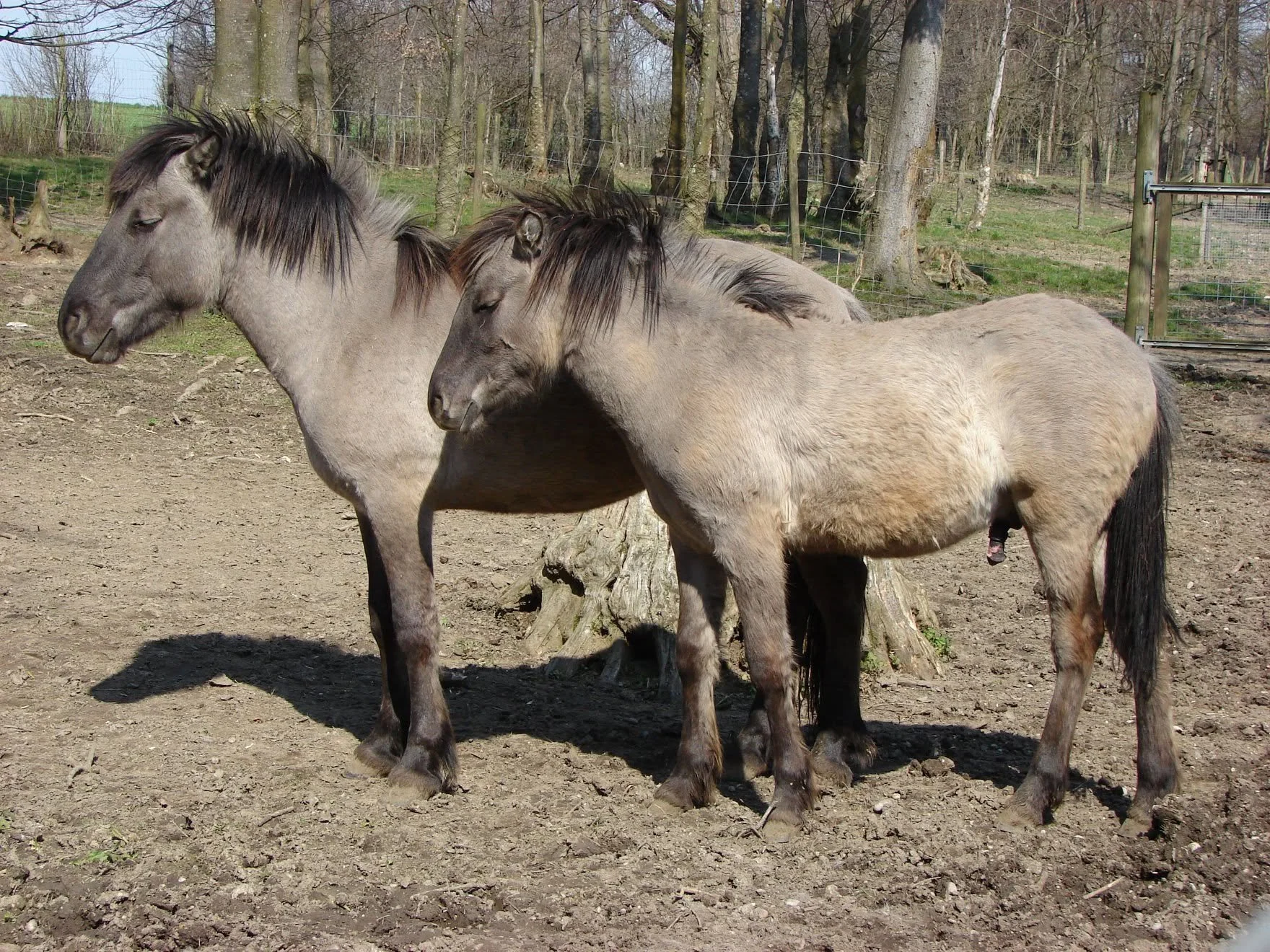
Tarpans