Today I want to talk about halters. I read a blog stating their view of rope halters versus web halters, and I disagreed with it so much that I feel compelled to bore you with my take on the subject.
The horse world is split into three camps when it comes to having a view on which is better, rope or web halters. People get hot under the collar on this subject as if they are starting a religious war. There is the pro-web collar brigade that believes that these are kinder and gentler devices that cause less stress and minimize the potential for harming a horse.
Then there is the fraternity of brothers and sisters who pray at the altar of the rope halter every day, believing that any other form of headgear is anti-training.
And thirdly, there is the fellowship of non-worshippers whose motto is “who gives a damn.” I proudly belong to this brotherhood.
Both web and rope halters have their pros and cons, and to argue that one is better than the other as a training device is ludicrous.
Let’s look at the differences.
The best thing about a web halter is they will break when under a lot of strain. Every buckle and clip is a weak point in the structure, and if a horse pulls back hard, the halter comes apart. This is a huge advantage if a horse is tied to something solid and puts all its effort into pulling. It’s much better to have a horse on the loose than one with spinal damage.
In this regard, rope halters don’t break. There are no weak spots in their structure because the entire halter is one continuous piece of rope. If I knew a horse was likely to pull back when tied up and it was wearing a rope halter, I would loop the lead rope around the post or use a sliding clip (like a Blocker tie) to ensure the rope gave if the horse pulled. I would never tie a horse with a known propensity to pull back to something solid, using a rope halter.
Web halters tend to be less abrasive, but rope halters can rub the skin and cause abrasions. Again, the weak spots on a web halter are the buckles, and these can create skin rashes if badly fitted or used violently. But most rope halters are made of rope that is pretty abrasive, and it doesn’t take a lot of friction to peel a few layers of epidermis off a horse’s face.
For the fashion-conscious, both web and rope halters can be bought in a huge range of colours and designs. I’ve got rope halters in red/white/blue, green/red, purple, black/white, yellow/black, and I even have a rainbow coloured halter. The rainbow halter was a gift from Ben and Sari in England. It doesn’t get used much because I’m waiting for when I have a rainbow coloured unicorn to match. So, as far as choosing a pretty halter, there is as much choice in the rope halter range as there is in the web halter.
Web halters perish. They will break down in the sun and from use. Rope halters last forever. I still have the same rope halter that I used when I rode across the Red Sea after Moses parted it. They last forever!
Anybody can make a rope halter. There are a million sites on the internet showing, with diagrams, how to turn 22 feet of rope into a halter. It just takes a little practice to get the dimensions right. But web halters are not so easy. They require some hardware and sewing skills.
I prefer not to use clips on my lead ropes because they are heavy and can whack horses quite severely during moments of high activity. Instead, I choose to either tie a lead rope to a halter or buy a lead rope with a spliced loop on one end that can be attached. Web halters are designed so that the lead rope is attached with a metal clip. A person can use a rope with a spliced loop instead, but most people use clips. On the other hand, rope halters often come with lead ropes and no clip, which I believe is a better option.
Finally, we come to the crux of the argument between the web halter loonies and the rope halter nutters. The debate is which is more effective in getting a change in a horse.
Those who hate rope halters argue that because the rope is small in diameter, the force exerted by a feel on the lead rope creates inordinately stronger pressure on the horse’s head. The wider strapping of a web halter means that for the same force on the lead rope, the horse experiences less pressure. Remember, pressure is the force divided by area. Therefore, if the force is the same, then the area of the halter that is in contact with the horse determines the pressure. The larger area of the web halter produces less pressure than the smaller area of the rope halter.
Fans of web halters think this is a good reason not to use a rope halter, and rope halter zealots believe it is the best reason to use them. But for me and my fellow brethren from the “who gives a damn”, camp, we understand that the pressure the horse experiences is actually in the hands of the primate holding the lead rope.
A halter sits on a horse’s head and does nothing. It offers no feel or gives no indication as to what is expected of a horse. It just sits there. Whatever communication a horse receives via the halter is the result of somebody putting a feel in the lead rope. Therefore, irrespective of what type of halter a horse is wearing, the pressure it experiences can be adjusted at the behest of the handler. If you are afraid that a rope halter is capable of applying too much pressure, then don’t apply so much force on the lead rope. It’s that simple
.
And for those people who like the idea that a rope halter gives them more control, I suggest you stop using them because no good horse person relies on out-muscling a horse to control it.
Lastly, this is to anyone who believes that either a web or rope halter is the only choice (including the trainer whose blog I read). You don’t get it.
If you believe a piece of flimsy material sitting on a horse’s head will make the difference between your horse going well or going poorly, then you are missing the point.
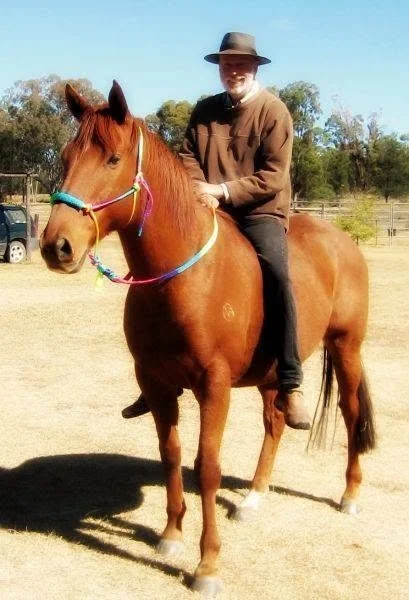
Until I get my rainbow coloured unicorn.